

 Español
Content
- 1 What a Coating Machine Does and How It Works
- 2 Primary Application: Pharmaceutical Tablet and Pill Coating
- 3 Food Industry Applications: From Chocolate to Spice Coating
- 4 Chemical and Light Industry Uses
- 5 Types of Coating Machines and Their Suitability
- 6 Rolling, Mixing, and Polishing Functions Beyond Simple Coating
- 7 Key Features to Look for When Selecting a Coating Machine
- 8 Operational Best Practices for Consistent Coating Quality
What a Coating Machine Does and How It Works
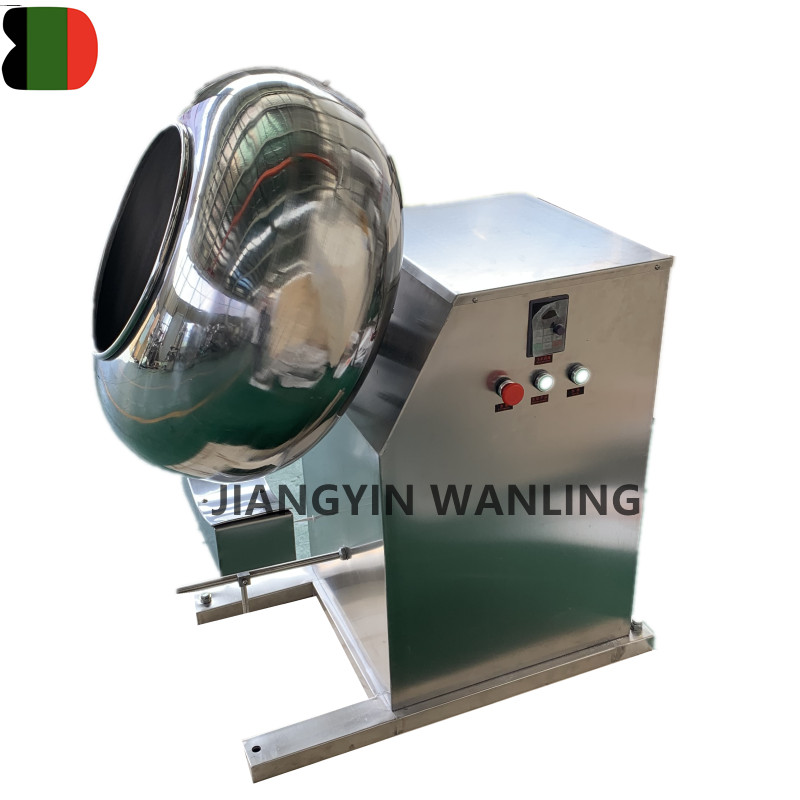
A coating machine is an industrial processing unit designed to apply a uniform layer of coating material — whether sugar syrup, film polymer, wax, chocolate, spice blend, or chemical compound — onto the surface of spherical, cylindrical, or granular substrates. The core operating principle relies on a rotating drum or pan that tumbles the substrate continuously while coating solution or material is applied through spray nozzles, pouring systems, or dusting mechanisms. As the drum rotates, the tumbling action ensures every particle or tablet is exposed to the coating material evenly, building up the desired layer thickness through repeated passes.
The process typically incorporates controlled airflow — either heated or ambient — directed into and out of the drum to manage drying or cooling rates. Temperature control is critical: too much heat causes the coating to dry before it adheres properly, while too little results in clumping or incomplete film formation. Modern coating machines integrate programmable logic controllers (PLCs) that automate spray rate, drum speed, inlet air temperature, and exhaust air humidity, ensuring consistent results batch after batch. The versatility of this fundamental operating mechanism is what allows a single machine platform to serve applications as diverse as pharmaceutical tablet coating, chocolate polishing, and rice ball manufacturing.
Primary Application: Pharmaceutical Tablet and Pill Coating
The pharmaceutical industry represents the most technically demanding and commercially significant application of coating machines. In tablet manufacturing, coating serves multiple essential functions that go far beyond aesthetics. Sugar coating — the traditional method — involves building up successive layers of sugar syrup, talc, and colorants around a compressed tablet core. This process, performed in a coating pan, produces the familiar smooth, glossy tablet surface that masks unpleasant taste and odor, protects the active pharmaceutical ingredient (API) from moisture and light degradation, and provides a surface suitable for imprinting brand or dosage information.
Film coating, which has largely replaced sugar coating in modern pharmaceutical manufacturing, uses polymer solutions — typically hydroxypropyl methylcellulose (HPMC), ethylcellulose, or polyvinyl alcohol (PVA) — sprayed onto tablets in a perforated coating drum. Film coatings are thinner, faster to apply, and more precisely controlled than sugar coatings. They can be formulated as immediate-release coatings that simply protect the tablet during storage and handling, or as functional coatings that modify drug release profiles — including enteric coatings that resist gastric acid and release the API only in the intestinal environment, and extended-release coatings that deliver the drug gradually over 8 to 24 hours.
Critical Pharmaceutical Coating Requirements
- Uniform coating thickness across all tablets in the batch, typically within ±2–5% weight gain variation
- Full compliance with GMP (Good Manufacturing Practice) guidelines and FDA 21 CFR Part 211 requirements
- Stainless steel contact surfaces with smooth, crevice-free finishes to prevent cross-contamination between products
- Validated cleaning procedures and complete process documentation for regulatory audit trails
- Precise inlet air temperature and humidity control to maintain coating solution viscosity and drying rate
Pharmaceutical coating machines are available in batch sizes ranging from laboratory-scale pans processing 1 to 5 kg for R&D purposes, to full production perforated drum coaters handling 300 to 600 kg per batch. High-efficiency perforated pan designs with optimized baffle geometries ensure tablet bed movement that minimizes coating time while eliminating tablet damage — a critical consideration for friable or low-density tablet formulations.
Food Industry Applications: From Chocolate to Spice Coating
The food industry represents an equally broad and commercially important application domain for coating machines, with the fundamental machine design adapted to handle food-grade materials and meet food safety standards. Chocolate polishing is one of the most widely recognized food coating applications: confectionery items such as chocolate-covered nuts, raisins, and candy centers are tumbled in a coating pan while chocolate or a confectionery glaze is applied in controlled quantities. The final polishing stage uses carnauba wax or shellac applied in small amounts to produce the high-gloss surface finish characteristic of premium chocolate confections.
Coated peanuts represent another classic food coating application. Raw or roasted peanuts are tumbled in a coating machine while sugar syrup, starch slurry, or flavored batter is applied incrementally and dried between applications to build up a crunchy shell. Successive coating layers — sometimes 20 to 40 passes — create the characteristic thick, crispy coating of products like honey-roasted peanuts or Japanese-style coated peanuts. Spice and seasoning coatings applied to snack products such as flavored nuts, crackers, and popcorn are similarly produced using drum coating machines that ensure even seasoning distribution without product breakage.
Rice ball and mochi manufacturing in Asian food production also employs coating machines to apply sesame seeds, coconut flakes, flavored powders, or glutinous rice coatings to formed centers. The gentle tumbling action of the coating drum applies these delicate coatings without crushing the soft centers — a capability that manual coating cannot replicate at production scale. Sugar-coated fennel seeds, anise candies, and similar mouth-freshening confections are produced using the same equipment.
Chemical and Light Industry Uses
Beyond pharmaceuticals and food, coating machines serve important functions in chemical processing and light manufacturing industries. In the fertilizer industry, granular fertilizers are coated with polymer films, sulfur, or inhibitor compounds to control nutrient release rates, improve handling characteristics, and reduce hygroscopicity. Controlled-release fertilizer coatings, applied in drum coating systems, allow farmers to apply fewer applications per season while maintaining consistent nutrient availability to crops — a significant agronomic and economic benefit.
In the catalyst manufacturing sector, coating machines apply active catalytic compounds or support materials onto spherical or pellet-form catalyst carriers. Uniform coating thickness is essential in this application because it directly determines the catalyst's surface area, activity, and selectivity. Unevenly coated catalyst particles produce inconsistent reaction rates and reduce process efficiency in chemical reactors.
Light manufacturing applications include the coating of decorative beads, buttons, and craft materials with lacquers, metallic finishes, or colored wax. The batch coating machine's drum gently tumbles these delicate items while applying coating by spray or pouring, producing a uniform decorative finish far more efficiently than manual dipping or spraying methods.
Types of Coating Machines and Their Suitability
| Machine Type | Operating Principle | Best For | Typical Industries |
| Standard Coating Pan | Open rotating pan with manual or spray application | Sugar coating, chocolate, small batches | Pharma, confectionery |
| Perforated Pan Coater | Perforated drum with through-airflow drying | Film coating, enteric coating | Pharmaceutical GMP production |
| Fluidized Bed Coater | Suspended particles coated in upward airstream | Fine granules, pellets, powders | Pharma, nutraceuticals, chemicals |
| Drum Coating Machine | Large rotating drum with baffles and spray system | Nuts, seeds, snack foods, fertilizers | Food, agriculture, chemical |
| Polishing Machine | Low-speed tumbling with wax or glaze application | Final gloss finish on coated products | Confectionery, pharma finishing |
Rolling, Mixing, and Polishing Functions Beyond Simple Coating
A coating machine's rotating drum is not limited to applying coating materials — it simultaneously performs rolling, mixing, and surface finishing functions that add further value to the processing operation. Rolling action in the drum rounds off sharp edges on granular or pellet substrates, improving flowability and reducing dust generation in downstream handling. This is particularly valuable in the production of controlled-release fertilizer pellets, catalyst beads, and nutraceutical granules where particle shape directly affects bulk handling characteristics and packaging efficiency.
The mixing function of the rotating drum ensures that multi-component dry blends, seasoning mixtures, or powdered coatings are distributed homogeneously across the entire batch surface rather than concentrated on portions of the product. In spice-coated snack production, for example, the drum coating machine ensures that every individual piece receives the same quantity of seasoning — a uniformity that is impossible to achieve manually at commercial production scale and that directly impacts consumer taste perception and product consistency.
Surface polishing — achieved in the final stages of the coating cycle by applying small amounts of polishing agent at reduced drum speed — improves the visual appeal of the finished product, reduces surface tackiness, and provides a moisture barrier that extends shelf life. In pharmaceutical tablets, the polished surface also improves swallowability and prevents tablets from sticking together during packaging and dispensing.
Key Features to Look for When Selecting a Coating Machine
Selecting the right coating machine for a specific application requires evaluating several technical and operational parameters that determine whether the machine will meet production, quality, and regulatory requirements consistently over its service life.
- Drum material and surface finish: Pharmaceutical applications require 316L stainless steel with electropolished internal surfaces. Food applications require food-grade stainless steel meeting FDA or EU food contact material regulations. Chemical applications may require specialized alloys or coatings for corrosion resistance.
- Drum speed variability: Variable-speed drives allow the operator to optimize tumbling action for different product densities and fragility levels — slower speeds for delicate confections, higher speeds for robust pharmaceutical tablets.
- Spray system precision: Peristaltic pumps with anti-drip nozzles and adjustable spray patterns ensure uniform coating distribution and prevent localized over-wetting that causes product agglomeration.
- Airflow and temperature control: Inlet air heaters with PID temperature controllers and exhaust air humidity sensors allow the drying process to be optimized and maintained within validated process windows.
- Cleaning and changeover design: Quick-release drum mounting, smooth interior geometry, and CIP (clean-in-place) compatibility reduce changeover time between products and prevent cross-contamination in multi-product facilities.
- Batch size flexibility: Machines with adjustable fill volumes or interchangeable drum sizes allow a single unit to handle both development-scale and production-scale batches, maximizing equipment utilization.
Operational Best Practices for Consistent Coating Quality
Achieving consistent coating quality batch after batch requires more than appropriate equipment — it demands disciplined process control, validated operating parameters, and systematic monitoring of key process indicators throughout every coating run. Before starting a batch, operators should verify that the drum is clean, dry, and free of residue from previous runs, that spray nozzles are unobstructed and correctly positioned, and that inlet air temperature has stabilized at the target setpoint. Pre-warming the drum and product load to operating temperature before beginning coating solution application prevents condensation on the tablet or particle surface that can cause coating defects.
During the coating process, monitoring exhaust air temperature provides real-time indication of the drying rate — a rising exhaust temperature indicates that drying capacity exceeds the moisture input from the spray, while a falling exhaust temperature suggests the spray rate is too high for the current airflow and temperature conditions. Weight gain monitoring through periodic sampling or in-process weighing confirms that coating buildup is progressing at the expected rate. At the conclusion of coating, a defined polishing and cooling cycle — with spray system off and airflow continuing — ensures that the coating is fully dried and the product temperature has returned to a level safe for discharge and packaging.
Whether the application is pharmaceutical tablet film coating in a GMP-certified facility, chocolate polishing in a confectionery plant, or spice coating in a snack food line, the coating machine's combination of controlled rotation, precise material application, and managed drying or cooling represents an irreplaceable technology for producing consistently high-quality coated products at commercial scale.