

 Español
A rapid mixer granulator (RMG) is the most widely used wet granulation equipment in pharmaceutical solid dosage manufacturing. It combines dry mixing, binder addition, wet massing, and granule formation in a single closed bowl — reducing process time, operator exposure, and cross-contamination risk compared to multi-step granulation with separate equipment. In a correctly operated RMG, the entire wet granulation cycle from dry mixing to discharge-ready granules takes 15 to 30 minutes, making it the benchmark for high-throughput tablet and capsule production lines.
Content
- 1 What a Rapid Mixer Granulator Does and Why It Matters
- 2 Key Components of a Rapid Mixer Granulator
- 3 The Granulation Process: Step-by-Step Inside the RMG
- 4 Critical Process Parameters and Their Effect on Granule Quality
- 5 Granulation Endpoint Detection Methods
- 6 RMG Scale-Up: Translating Lab Results to Production
- 7 Troubleshooting Common RMG Granulation Problems
- 8 GMP Compliance and Cleaning Requirements for RMGs
- 9 Comparing RMG with Other Granulation Technologies
What a Rapid Mixer Granulator Does and Why It Matters
Granulation — the process of aggregating fine powder particles into larger, free-flowing granules — is a critical intermediate step in tablet manufacturing. Granules compress more uniformly than raw powders, reduce segregation of active pharmaceutical ingredients (APIs), improve flow through tablet press feed frames, and enhance content uniformity in the final dosage form.
Before the RMG became standard, wet granulation required a planetary mixer for dry blending, a separate granulator for wet massing, and a manual or mechanical transfer step between them — all open to contamination and operator variability. The RMG consolidates these into one vessel with controlled, reproducible mechanical energy input, making scale-up and batch-to-batch consistency significantly more achievable.
RMGs are used across pharmaceutical, nutraceutical, veterinary, and food industries wherever wet granulation produces superior downstream processing results over direct compression or dry granulation.
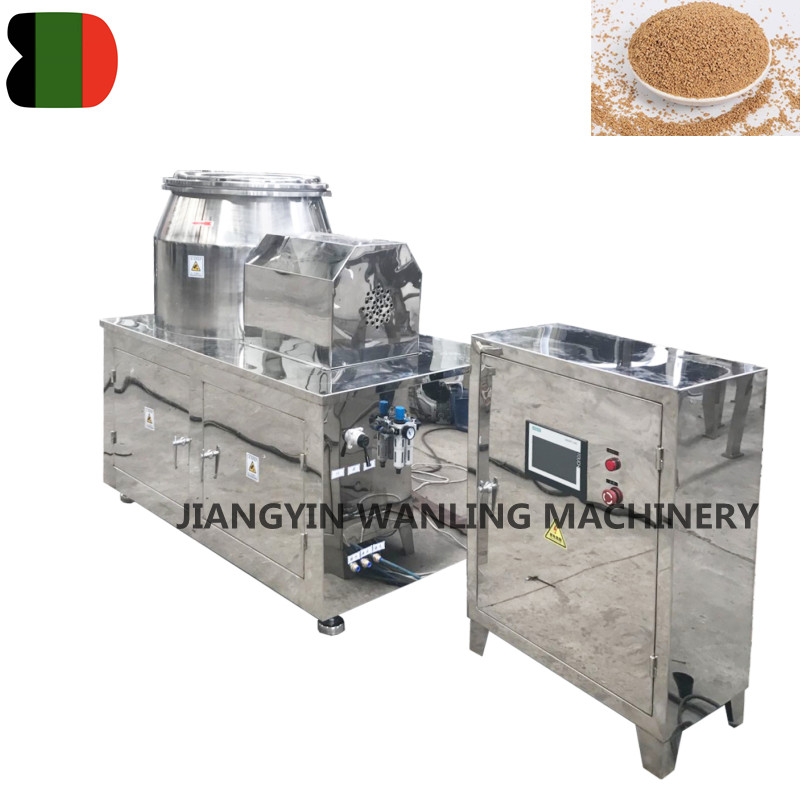
Key Components of a Rapid Mixer Granulator
Understanding the function of each component is essential for both operating the RMG correctly and troubleshooting granulation failures. Every part of the machine directly influences granule properties.
The Mixing Bowl
The bowl is the primary containment vessel, typically fabricated from 316L stainless steel with an electropolished interior surface (Ra ≤ 0.8 µm) to prevent powder adhesion, facilitate cleaning, and comply with GMP requirements. Bowl geometry — particularly the bottom contour and wall angle — is engineered to work with the impeller sweep pattern, ensuring powder at the bowl periphery is continuously returned to the mixing zone rather than remaining static. Bowls are available in working capacities from 1 L (laboratory scale) to 1,200 L (production scale), though standard production bowls in the pharmaceutical industry typically range from 150 to 600 L.
The Main Impeller
The impeller is the central mixing element, driven by a bottom-mounted motor through a shaft sealed against powder ingress. It rotates at two selectable speeds — slow (typically 100–200 rpm) and fast (250–500 rpm) — with the slow speed used for dry mixing and initial binder addition, and the fast speed used during wet massing to develop granule density and size. The impeller blade geometry varies by manufacturer but is designed to create a three-dimensional powder flow pattern: material moves radially outward along the bowl floor, rises up the bowl wall, and returns inward across the powder surface — a toroidal circulation that ensures complete mixing.
The Chopper
The chopper is a small, high-speed blade (typically 1,500–3,000 rpm) mounted on the side wall of the bowl, positioned in the zone where powder accumulates during impeller rotation. Its function is to break up agglomerates and lumps formed during wet massing, preventing the formation of oversized granules and distributing the binder solution more uniformly through the mass. The chopper operates intermittently or continuously depending on the formulation — sticky or high-API-load formulations typically require more aggressive chopper use. Without the chopper, granule size distribution broadens significantly and the proportion of oversize material increases.
Binder Addition System
Binder solution is added through a spray nozzle or pour port located in the bowl lid. Spray addition is preferred over pour addition in modern RMGs because it distributes the liquid more evenly across the powder bed surface, reducing the risk of localized overwetting. The spray system typically uses a peristaltic pump with programmable flow rate control, allowing the binder addition rate to be precisely matched to the powder's liquid uptake capacity — a critical parameter for reproducible granulation.
Discharge Port and Seal System
Wet granules are discharged through a side-mounted port controlled by a pneumatically or hydraulically operated discharge valve. In GMP-compliant machines, the discharge area is designed for contained transfer directly into a wet mill or fluid bed dryer. Shaft seals and bowl lid gaskets use FDA-compliant elastomers (typically silicone or EPDM) and are accessible for inspection and replacement without tools in modern designs.
The Granulation Process: Step-by-Step Inside the RMG
A standard wet granulation cycle in an RMG follows a defined sequence of stages, each with specific equipment settings and process objectives.
- Dry mixing: API and excipients are loaded into the bowl and mixed at slow impeller speed (typically 150 rpm) for 3–5 minutes with the chopper off or at low speed. The objective is to achieve a homogeneous powder blend before any liquid is added. Lumps in poorly flowing powders may require brief chopper activation during this stage.
- Binder addition: Granulating liquid (binder solution or water, depending on the formulation) is added through the spray system at a controlled rate while the impeller runs at slow speed. The addition rate is formulation-specific — too fast causes localized overwetting and lump formation; too slow extends process time unnecessarily. Typical addition times range from 3 to 10 minutes.
- Wet massing: After binder addition is complete, impeller speed is increased to fast speed and the chopper is activated. This stage develops granule nuclei into denser, more spherical particles through the combined shear forces of impeller circulation and chopper action. Wet massing duration is one of the most critical variables — it directly controls granule size, density, and porosity. Typical wet massing time ranges from 2 to 8 minutes depending on formulation.
- Endpoint determination: The granulation endpoint — the point at which granules have the optimal size and moisture distribution for drying and subsequent compression — is determined by power consumption monitoring, torque measurement, or manual squeeze test. Modern RMGs use real-time power or torque curves to detect endpoint automatically.
- Discharge: Once the endpoint is confirmed, the discharge valve opens and the impeller rotation directs granules through the discharge port into a wet mill (if size reduction is needed) and then into the dryer.
Critical Process Parameters and Their Effect on Granule Quality
Granule properties — and ultimately tablet quality — are determined by how process parameters are set and controlled during the RMG cycle. Each parameter has a defined effect that must be understood for both development and routine production.
| Process Parameter | Typical Range | Effect if Too Low | Effect if Too High |
|---|---|---|---|
| Impeller Speed (Wet Massing) | 250–500 rpm | Soft, porous granules; poor flow | Overworked mass; dense, hard granules; poor compressibility |
| Chopper Speed | 1,500–3,000 rpm | Large agglomerates; wide size distribution | Excessive fines; reduced yield |
| Binder Addition Rate | Formulation-specific (g/min) | Uneven wetting; fines-rich granules | Localized overwetting; lump formation |
| Granulating Liquid Volume | 15–35% w/w of dry powder | Insufficient binding; friable granules | Overwet mass; paste formation; dryer overload |
| Wet Massing Time | 2–8 minutes | Small, fragile granules; poor compaction | Oversized, dense granules; poor dissolution |
| Bowl Load (Fill Level) | 25–75% of total bowl volume | Poor mixing; uneven granulation | Impeller overload; discharge difficulty |
Wet Massing Time: The Most Sensitive Variable
Of all the parameters listed, wet massing time has the steepest impact on granule properties in most formulations. Studies published in pharmaceutical journals have demonstrated that extending wet massing time by as little as 2 minutes beyond the optimum can increase mean granule size by 30–50% and reduce tablet disintegration time compliance in the final product. This sensitivity is why endpoint detection systems — rather than fixed time-based endpoints — are now standard in modern GMP-compliant RMG installations.
Granulation Endpoint Detection Methods
Reliably detecting the granulation endpoint is one of the most important — and historically most challenging — aspects of RMG operation. Fixed-time endpoints are simple but inherently vulnerable to raw material variability. Several more robust methods are used in modern pharmaceutical manufacturing.
Power Consumption Monitoring
As granules grow and the powder mass becomes denser and wetter, the resistance to impeller rotation increases — and this is reflected as a measurable increase in the electrical power drawn by the impeller motor. The power consumption profile over time follows a characteristic curve: it rises during binder addition, plateaus or shows a secondary rise during wet massing, and then either stabilizes (indicating endpoint) or continues to rise (indicating overwetting risk). Power consumption monitoring is the most widely validated endpoint detection method in regulatory submissions for RMG processes and is recommended in several FDA process analytical technology (PAT) guidance documents.
Torque Measurement
Similar in principle to power monitoring, torque measurement directly quantifies the rotational resistance experienced by the impeller shaft. Some manufacturers integrate torque sensors directly into the impeller drive system for higher sensitivity than indirect power measurement. Torque-based endpoints correlate well with granule density and moisture content, and the method is particularly useful for formulations where the power curve shows a shallow or ambiguous plateau.
Near-Infrared (NIR) Spectroscopy
NIR probes mounted in the bowl lid or wall can monitor granule moisture content in real time throughout the granulation cycle. Because moisture content is directly related to granule growth and endpoint, NIR provides a chemically specific endpoint signal rather than an indirect mechanical one. NIR-based endpoint control is an example of PAT implementation in RMG operations, aligned with the FDA's 2004 PAT guidance framework. The method requires initial calibration against reference moisture measurements but delivers real-time, non-destructive moisture data that can be used for closed-loop feedback control of binder addition.
In-Process Particle Size Measurement
Focused beam reflectance measurement (FBRM) probes can be inserted into the RMG bowl to measure chord length distribution of granules in real time. As granules grow, the chord length distribution shifts to larger values. A stable chord length distribution indicates that granule growth has ceased and the endpoint has been reached. FBRM is used primarily in pharmaceutical development and PAT-enabled manufacturing lines rather than routine production due to cost and calibration complexity.
RMG Scale-Up: Translating Lab Results to Production
Scale-up from laboratory or pilot RMG to full production scale is one of the most technically demanding challenges in pharmaceutical process development. Because RMG granulation is driven by specific mechanical energy (SME) — the energy input per unit mass of powder — rather than simple time or speed, direct transfer of parameters between bowl sizes requires careful recalculation.
The Froude Number Approach
The most widely used dimensionless scale-up parameter for RMG is the Froude number (Fr), defined as Fr = ω²r/g, where ω is impeller angular velocity, r is impeller radius, and g is gravitational acceleration. Maintaining a constant Froude number across different bowl sizes ensures geometrically similar flow patterns in the powder bed. In practice, this means impeller tip speed — rather than impeller rpm — is held constant during scale-up. A 600 L production RMG impeller with a larger diameter must rotate at a proportionally lower rpm than a 25 L lab RMG impeller to deliver the same tip speed and equivalent Froude number.
Specific Energy Input as a Scale-Up Anchor
An increasingly preferred scale-up strategy is matching specific energy input (kJ/kg) — the cumulative power consumed divided by batch mass — between scales. Because granule properties (size, density, and strength) correlate strongly with the total mechanical energy delivered to the powder bed, batches processed to the same specific energy at different scales tend to produce granules with similar properties. This approach is particularly useful when power monitoring is available at both scales and is compatible with regulatory expectations for science-based process design.
Common Scale-Up Failures and How to Avoid Them
Several specific failure modes are commonly encountered during RMG scale-up:
- Over-granulation at production scale: Caused by higher heat generation in larger bowls (less surface area relative to volume) combined with longer binder addition times. Mitigation: cool the bowl jacket and reduce wet massing time relative to lab scale.
- Uneven binder distribution: At larger scale, spray coverage of the larger powder bed surface is proportionally reduced. Mitigation: use multiple spray nozzles or increase nozzle spray angle at production scale.
- Chopper ineffectiveness: A chopper sized for a 25 L bowl may be geometrically inadequate in a 600 L bowl. Ensure that chopper blade dimensions and position are scaled proportionally, not simply replicated from the smaller machine.
- Variable raw material lots: Particle size distribution and moisture content of incoming API and excipients affect liquid uptake rates. Process parameters validated with one raw material lot may not transfer directly to subsequent lots — endpoint detection rather than fixed parameters is the robust solution.
Troubleshooting Common RMG Granulation Problems
Even well-developed processes encounter granulation problems in production. Understanding root causes enables faster resolution with minimal batch losses.
| Problem | Likely Root Cause | Corrective Action |
|---|---|---|
| Excessive fines (>30% below 150 µm) | Insufficient binder, too little liquid, short wet massing | Increase binder concentration or liquid volume; extend wet massing time |
| Oversized lumps / agglomerates | Rapid binder addition, chopper speed too low, localized overwetting | Reduce binder addition rate; increase chopper speed; check spray nozzle uniformity |
| Wet mass sticks to bowl wall | Overwetting; high-tack binder; elevated bowl temperature | Reduce liquid volume; cool bowl jacket; consider binder type change |
| Poor content uniformity in granules | Insufficient dry mixing; API segregation before binder addition | Extend dry mixing time; pre-screen API; check impeller pattern |
| Batch-to-batch granule size variability | Fixed time endpoint with variable raw material moisture or particle size | Switch to power/torque-based endpoint detection |
| Hard, poorly compressible granules | Over-granulation; excessive wet massing time or speed | Reduce wet massing time; lower impeller speed; verify endpoint earlier |
GMP Compliance and Cleaning Requirements for RMGs
In pharmaceutical manufacturing, the RMG must meet rigorous Good Manufacturing Practice (GMP) standards for equipment design, cleaning validation, and documentation. These requirements are embedded in 21 CFR Part 211 (FDA), EU GMP Annex 15, and relevant ICH guidelines.
Design for Cleanability
All product-contact surfaces must be smooth, crevice-free, and accessible for cleaning verification. Modern RMGs feature tool-free impeller and chopper removal, flush-mounted bowl bottom drains, and CIP (clean-in-place) spray ball systems that deliver cleaning agents to all internal bowl surfaces without manual intervention. The bowl jacket must be separately cleanable if cooling water is used. Any area that cannot be visually inspected or swab-sampled after cleaning is a non-conformance risk under GMP audit.
Cleaning Validation
Cleaning validation for an RMG requires demonstrating that residual API and cleaning agent levels on all product-contact surfaces after cleaning meet pre-defined acceptance criteria — typically based on 10 ppm carryover limit or 1/1000th of the minimum therapeutic dose of the previous product, whichever is more stringent. Swab samples are taken from defined locations — bowl floor, bowl wall, impeller blades, chopper blades, discharge valve, and shaft seal areas — and analyzed by validated HPLC or TOC methods.
Process Documentation and Electronic Records
Modern RMGs incorporate PLC-based control systems with SCADA integration that record all process parameters — impeller speed, chopper speed, power consumption, binder addition volume and rate, process temperatures, and batch times — with time stamps throughout the granulation cycle. These records constitute the electronic batch record (eBR) for the granulation step and must meet 21 CFR Part 11 requirements for data integrity: audit trails, access controls, and prevention of unauthorized data modification.
Comparing RMG with Other Granulation Technologies
The RMG is not the only wet granulation technology, but it occupies a specific and important niche defined by throughput, granule density, and process integration advantages.
| Technology | Mechanism | Granule Density | Throughput | Key Advantage | Key Limitation |
|---|---|---|---|---|---|
| Rapid Mixer Granulator (RMG) | High-shear wet massing | High | High (batch) | Fast, contained, scalable | Sensitive to overwetting; batch process |
| Fluid Bed Granulator (FBG) | Spray granulation in fluidized bed | Low–Medium | Medium (batch) | Simultaneous drying; porous granules | Longer cycle; dust/attrition risk |
| Twin-Screw Granulator (TSG) | Continuous wet granulation via extruder | Medium–High | Very High (continuous) | Continuous manufacturing; real-time control | High capital cost; complex validation |
| Roller Compaction (Dry Granulation) | Compaction between rollers; no liquid | Medium | High (continuous) | Suitable for moisture-sensitive APIs | Reduced compressibility; API stress |
The RMG's dominance in pharmaceutical manufacturing is explained by its combination of short cycle time, high granule density (favorable for tablet compression), contained processing, and a well-established validation history that regulators and quality systems are familiar with. For moisture-sensitive APIs or formulations where granule porosity is critical for dissolution, fluid bed or dry granulation may be preferred — but the RMG remains the default choice for the majority of tablet formulations where wet granulation is appropriate.