

 Español
Choosing the right dryer machine depends on your material properties, required final moisture content, batch size, and industry regulations. The four most widely used industrial dryer types are the fluidized bed dryer, the hot air tray dryer, the vibrating fluid bed dryer, and the double cone vacuum dryer. Each operates on a different principle and excels under different conditions. Understanding their mechanics, performance data, and limitations allows engineers and procurement teams to make decisions that directly affect product quality, energy cost, and throughput.
Content
- 1 How Each Dryer Machine Works: Core Operating Principles
- 2 Side-by-Side Comparison of the Four Dryer Types
- 3 Fluidized Bed Dryer: Strengths, Configurations, and Practical Limits
- 4 Hot Air Tray Dryer: Versatility and When It Remains the Right Choice
- 5 Vibrating Fluid Bed Dryer: Continuous Processing for Difficult Materials
- 6 Double Cone Vacuum Dryer: Best Practice for Heat-Sensitive and Solvent-Wet Materials
- 7 Key Selection Criteria When Choosing a Dryer Machine
- 8 Energy Efficiency Across Dryer Machine Types
- 9 Maintenance Priorities for Each Dryer Machine Type
How Each Dryer Machine Works: Core Operating Principles
Fluidized Bed Dryer
A fluidized bed dryer forces heated air upward through a perforated distributor plate at a velocity sufficient to suspend the product particles in a turbulent, fluid-like state. Each particle is surrounded by moving hot air on all sides, creating extremely efficient heat and mass transfer. Drying times are short, typically 20 to 40 minutes for pharmaceutical granules, compared to several hours in static systems. The fluidized state also produces a highly uniform final moisture content across the batch.
Hot Air Tray Dryer
A hot air tray dryer loads material onto a series of perforated or solid trays stacked inside an insulated cabinet. A fan circulates heated air across or through the trays at controlled temperature and velocity. Heat transfer is convective but less aggressive than fluidization because the product remains static. Drying times are longer, often ranging from 4 to 24 hours depending on material thickness, moisture load, and temperature settings. The simplicity of the design makes it one of the most versatile and widely adopted dryer machines in laboratories, pilot plants, and small-scale production.
Vibrating Fluid Bed Dryer
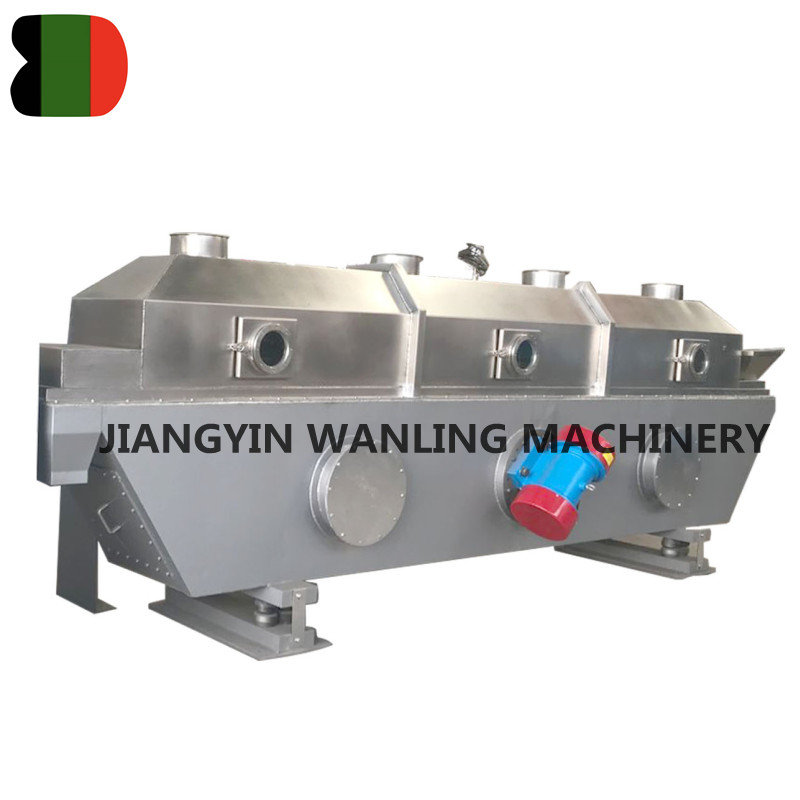
A vibrating fluid bed dryer combines mechanical vibration with a controlled airflow below the fluidization velocity. The vibration conveys material horizontally through a series of drying zones while maintaining gentle contact between particles and the heated airstream. This hybrid approach allows materials that are too fragile, too heavy, or too sticky to fluidize conventionally to still benefit from continuous, uniform drying. It is commonly used for food ingredients, chemicals, and coarse granules that would be damaged by full fluidization turbulence.
Double Cone Vacuum Dryer
A double cone vacuum dryer operates under reduced pressure inside a rotating, double-cone-shaped vessel whose jacket is heated by steam or hot water. Rotation tumbles the material continuously while vacuum lowers the boiling point of the solvent or moisture being removed. Because drying occurs at temperatures as low as 40 to 60 degrees Celsius under vacuum, it is the preferred choice for heat-sensitive active pharmaceutical ingredients, fine chemicals, and materials containing flammable or recoverable solvents.
Side-by-Side Comparison of the Four Dryer Types
The table below summarizes the practical differences across the key selection criteria that matter most to process engineers and plant managers.
| Criterion | Fluidized Bed Dryer | Hot Air Tray Dryer | Vibrating Fluid Bed Dryer | Double Cone Vacuum Dryer |
|---|---|---|---|---|
| Drying Speed | Fast (20-40 min) | Slow (4-24 hrs) | Moderate (continuous) | Moderate (4-12 hrs) |
| Heat Sensitivity | Moderate tolerance | Low to moderate | Moderate tolerance | Excellent for sensitive |
| Particle Fragility | Not suitable for fragile | Excellent | Good | Good |
| Solvent Recovery | Difficult | Not practical | Limited | Excellent |
| Batch vs Continuous | Both available | Batch | Continuous | Batch |
| Capital Cost | Moderate to high | Low | High | Moderate to high |
| Typical Industries | Pharma, chemicals, food | Pharma, lab, food | Food, fertilizer, minerals | Pharma, fine chemicals |
Fluidized Bed Dryer: Strengths, Configurations, and Practical Limits
The fluidized bed dryer is the benchmark for high-speed, high-uniformity drying in batch pharmaceutical and chemical production. Its high surface area contact between particle and air produces thermal efficiency values of 60 to 80 percent, significantly higher than static tray systems. Modern units integrate granulation and coating functions into the same vessel, reducing product transfer steps and contamination risk.
Key configurations include top-spray, bottom-spray (Wurster), and tangential-spray arrangements, each suited to different granule sizes and coating requirements. Batch fluidized bed dryers used in oral solid dosage pharmaceutical manufacturing typically handle 50 to 600 kg per batch, with larger production models exceeding 1,000 kg.
However, fluidized bed dryers are not universally applicable. Materials with broad particle size distributions can segregate during fluidization, with fines elutriated into the exhaust air and coarse particles settling on the distributor plate. Very sticky, cohesive, or high-density materials may not fluidize at all without mechanical agitation assistance. Fine dust generated during fluidization also requires robust bag filter or HEPA filtration systems to prevent product loss and maintain containment in potent compound processing.
Hot Air Tray Dryer: Versatility and When It Remains the Right Choice
Despite being a mature technology, the hot air tray dryer remains widely used because of its simplicity, low capital investment, and suitability for a broad range of materials and batch sizes. A standard pharmaceutical tray dryer with 24 to 48 trays can process batches ranging from a few kilograms to several hundred kilograms, making it practical for product development, clinical trial manufacturing, and small-scale commercial production.
Temperature control in modern hot air tray dryers is precise, typically within plus or minus 2 degrees Celsius of setpoint across all zones, which is critical for products with narrow acceptable moisture specifications. Some designs incorporate programmable multi-step drying profiles that ramp temperature gradually to avoid case hardening, a defect where rapid surface drying forms a hard outer shell that traps moisture inside the particle.
The main operational challenge with tray dryers is non-uniform drying across the tray stack due to airflow variation between trays. Rotating trays manually or through automated turntables during the drying cycle and using perforated trays to allow through-air drying are standard corrective practices. Labor content is higher than automated continuous systems because trays must be loaded, unloaded, and cleaned between batches.
- Best suited for pastes, wet granules, sliced materials, and irregularly shaped products that cannot be fluidized
- Commonly used for herbs, botanicals, food products, and pharmaceutical wet granules at the pilot scale
- Operates effectively between 40 and 120 degrees Celsius, with some high-temperature models reaching 200 degrees Celsius
- GMP-compliant stainless steel construction with validated temperature mapping is available for regulated industries
Vibrating Fluid Bed Dryer: Continuous Processing for Difficult Materials
The vibrating fluid bed dryer was developed specifically to address the material handling limitations of conventional fluidization. By applying mechanical vibration at frequencies typically between 5 and 50 Hz and amplitudes of 2 to 6 mm, the dryer assists particle movement and reduces the minimum fluidization velocity needed to keep material in motion. This extends the range of processable materials to include wet or sticky products, high-bulk-density granules, and fragile crystals that would attrite in a conventional fluidized bed.
Material flows horizontally through distinct drying zones within the vibrating trough, progressing from high-moisture inlet to low-moisture outlet in a single pass. This continuous flow design is well suited to high-volume production where consistent throughput is more important than small batch flexibility. Common applications include drying of salt, sugar, fertilizer granules, instant coffee, and spray-dried powders.
The mechanical vibration system requires regular maintenance of springs, drive motors, and eccentric weights. Compared to a simple tray dryer, the vibrating fluid bed dryer has more moving parts and a higher initial cost, but its continuous output and gentle handling of fragile materials often justify the investment in high-throughput production environments.
Double Cone Vacuum Dryer: Best Practice for Heat-Sensitive and Solvent-Wet Materials
The double cone vacuum dryer occupies a specific and critical niche: it is the preferred dryer machine when the material is heat-sensitive, the liquid being removed is a flammable or high-value organic solvent, or when oxygen exclusion during drying is required to prevent oxidation or explosion risk.
Under vacuum conditions of 5 to 50 mbar, water evaporates at temperatures between 33 and 65 degrees Celsius rather than 100 degrees Celsius at atmospheric pressure. Organic solvents such as ethanol, acetone, and isopropanol evaporate at even lower temperatures. This low-temperature operation preserves the chemical integrity of active pharmaceutical ingredients, enzyme preparations, and fine chemicals that would degrade or discolor at conventional drying temperatures.
The solvent vapor removed under vacuum passes through a condenser where it is recovered as liquid. Recovery efficiencies of 95 percent or higher are achievable with properly sized condensers, making the double cone vacuum dryer economically attractive when solvents are expensive or when environmental regulations require solvent capture rather than atmospheric venting.
Rotation of the double cone vessel at speeds of 3 to 10 rpm provides gentle tumbling action that continuously exposes new product surface to the heated jacket and prevents lump formation. Vessel sizes range from laboratory units of less than 5 liters to commercial units of 3,000 to 10,000 liters working volume in large-scale API and specialty chemical manufacturing.
Key Selection Criteria When Choosing a Dryer Machine
Selecting the right dryer machine involves evaluating several process and material variables systematically. Rushing this decision leads to equipment that underperforms, requires costly retrofitting, or damages product quality.
- Material thermal sensitivity: Determine the maximum allowable product temperature. If it falls below 60 degrees Celsius, a vacuum dryer is almost always required. If thermal tolerance extends to 80 degrees Celsius or higher, fluidized bed or tray drying becomes viable.
- Particle characteristics: Assess particle size distribution, density, cohesiveness, and fragility. Free-flowing granules above 100 microns are good candidates for fluidized bed drying. Fragile crystals, pastes, or coarse heterogeneous materials favor tray or vibrating fluid bed systems.
- Liquid type: Water-based systems are compatible with all four dryer types. Organic solvents require either a vacuum dryer with solvent recovery or a fluidized bed dryer equipped with nitrogen inert gas recirculation and a condenser to handle flammable vapor safely.
- Required throughput and batch size: High-volume continuous production favors vibrating fluid bed dryers. Moderate batch pharmaceutical production is well served by fluidized bed dryers. Small batch or diverse product portfolios are best handled by tray dryers due to their flexibility and low changeover cost.
- Final moisture specification: Very low final moisture targets below 0.5 percent are more reliably achieved in vacuum or fluidized bed dryers than in tray dryers, where airflow gradients can leave localized moist zones.
- Regulatory environment: Pharmaceutical and food products intended for regulated markets require dryer machines with validated temperature distribution, traceable data recording, and cleanable surfaces meeting GMP standards. All four dryer types are available in GMP configurations, but qualification effort varies significantly.
Energy Efficiency Across Dryer Machine Types
Energy consumption in drying operations can represent a significant share of total manufacturing cost, particularly in large-scale continuous production. Specific energy consumption, measured as energy input per kilogram of water evaporated, varies considerably across the four dryer types.
| Dryer Type | Specific Energy (kJ per kg water) | Thermal Efficiency | Primary Energy Loss Source |
|---|---|---|---|
| Fluidized Bed Dryer | 2,800 to 3,500 | 60 to 80% | Exhaust air heat loss |
| Hot Air Tray Dryer | 4,500 to 6,000 | 35 to 55% | Leakage, long cycle time |
| Vibrating Fluid Bed Dryer | 3,000 to 4,000 | 55 to 70% | Mechanical vibration energy |
| Double Cone Vacuum Dryer | 3,200 to 5,000 | 50 to 65% | Vacuum pump and condenser load |
Fluidized bed dryers generally achieve the best thermal efficiency among the four types because the intimate contact between air and particles minimizes the energy required to evaporate each kilogram of moisture. Exhaust air heat recovery systems, in which outgoing hot air preheats incoming fresh air through a heat exchanger, can reduce fluidized bed dryer energy consumption by a further 20 to 30 percent in large continuous installations.
Maintenance Priorities for Each Dryer Machine Type
Preventive maintenance requirements differ significantly across these dryer technologies. Aligning maintenance schedules with operational demands prevents unplanned downtime and product quality failures.
- Fluidized bed dryer: Inspect and replace the distributor plate screen regularly, as clogging reduces airflow uniformity and causes channeling. Bag filters or cartridge filters above the product bowl require cleaning or replacement after each batch to maintain airflow and prevent cross-contamination.
- Hot air tray dryer: Calibrate temperature sensors and validate airflow distribution across all tray positions at defined intervals. Door seals and insulation panels should be inspected for integrity to prevent heat loss and condensation on cold surfaces.
- Vibrating fluid bed dryer: Inspect vibration drive springs and eccentric weight assemblies for fatigue cracks, as mechanical failure in these components can cause sudden and severe equipment damage. The vibrating trough screen also requires periodic replacement due to metal fatigue from continuous vibration.
- Double cone vacuum dryer: Maintain vacuum pump oil levels and condenser cooling water flow consistently. Rotary shaft seals where the vessel connects to the drive system are a common wear item and should be inspected at every turnaround. Verify jacket pressure rating and safety relief valve function before each steam heating cycle.