

 Español
A fluid bed dryer is one of the most efficient and widely used drying technologies in pharmaceuticals, food processing, chemicals, and agriculture — and its core advantage is straightforward: by suspending particles in an upward stream of heated air, it maximizes the surface area exposed to the drying medium, achieving drying rates 5–10 times faster than tray or rotary dryers for the same energy input. Understanding how fluid bed dryers work, which configuration suits a given material, and how to optimize operating parameters is directly actionable for engineers, process designers, and procurement teams selecting drying equipment.
Content
- 1 How a Fluid Bed Dryer Works
- 2 Types of Fluid Bed Dryers and Their Applications
- 3 Fluid Bed Dryers in Pharmaceutical Manufacturing
- 4 Fluid Bed Drying in Food Processing and Chemical Industries
- 5 Key Operating Parameters and How to Optimize Them
- 6 Common Problems in Fluid Bed Drying and How to Resolve Them
- 7 Energy Efficiency and Sustainability in Fluid Bed Drying
How a Fluid Bed Dryer Works
The operating principle of a fluid bed dryer is fluidization — a phenomenon where a bed of solid particles is transformed into a fluid-like state by passing a gas (typically heated air) upward through it at a velocity sufficient to overcome the gravitational force on the particles. At the correct air velocity, individual particles become suspended and move freely, behaving like a boiling liquid. This state is called the fluidized bed.
Heat and mass transfer in a fluidized bed are exceptionally efficient because every particle is surrounded by moving hot air on all sides simultaneously — unlike tray drying, where only the exposed upper surface of a product layer contacts the drying medium. The vigorous particle movement also prevents localized overheating, producing a remarkably uniform temperature distribution throughout the bed, typically within ±2–5°C of the setpoint even in large-scale equipment.
The Key Components of a Fluid Bed Dryer
- Air handling unit (AHU): Draws ambient air through a pre-filter, heats it to the setpoint temperature (typically 40–120°C depending on product), and delivers it to the drying chamber at the required flow rate. The AHU also controls inlet air humidity, critical for moisture-sensitive products.
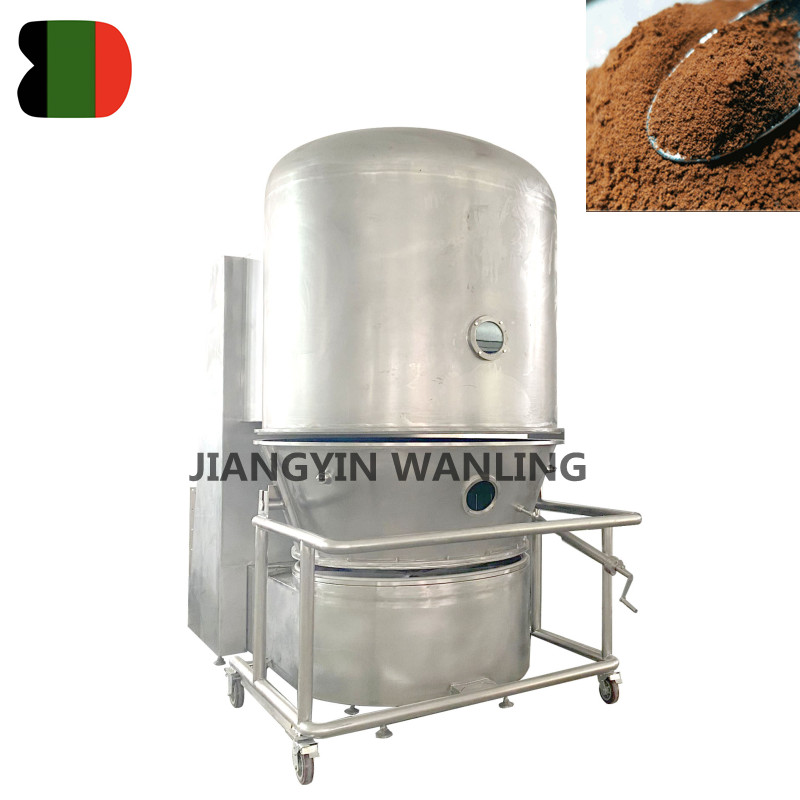
- Product container / bowl: The vessel holding the product bed, designed with a conical or cylindrical lower section that tapers to a perforated distribution plate. The taper creates a velocity gradient that promotes particle circulation and prevents dead zones.
- Perforated distribution plate (air distributor): A plate with precisely sized and spaced holes through which the fluidizing air enters the product bed. Plate design — hole size, open area percentage, and pattern — is critical for achieving uniform fluidization across the entire bed cross-section.
- Bag filter / finger bags: Fabric filter bags positioned in the expansion chamber above the product bed to capture fine particles (fines) carried upward by the air stream. Fines are periodically shaken or pulsed back into the bed, maintaining product yield and preventing filter blinding.
- Exhaust system: Draws the moisture-laden air out of the dryer after it has passed through the product bed and filter bags. Exhaust air monitoring (temperature and relative humidity) provides real-time endpoint detection capability.
Fluidization Velocity: The Critical Operating Parameter
Successful fluidization requires operating within a specific air velocity window bounded by two critical velocities. The minimum fluidization velocity (Umf) is the lowest air velocity at which the bed transitions from a fixed packed state to a fluidized state — below this, the bed sits static and drying is inefficient. The terminal velocity (Ut) is the velocity at which drag force equals particle weight — above this, particles are elutriated (carried out of the bed) and lost to the exhaust. Operating velocity is typically set at 2–5 times Umf to ensure vigorous fluidization while remaining well below Ut for the particle size distribution present.
Both Umf and Ut depend on particle size, density, and shape — which means any material change requires a re-evaluation of the operating velocity window. This is a common source of problems when scaling up from laboratory to production: the particle size distribution and bulk density of a production batch often differ from the lab material, shifting the velocity window significantly.
Types of Fluid Bed Dryers and Their Applications
The fluid bed dryer family encompasses several distinct configurations, each optimized for different material characteristics, throughput requirements, and process objectives. Selecting the right type is as important as selecting the right operating parameters.
Batch Fluid Bed Dryer
The batch fluid bed dryer is the most common configuration in pharmaceutical manufacturing and laboratory-scale food processing. A defined quantity of wet product is loaded into the bowl, dried to the target moisture specification, and discharged before the next batch is loaded. Batch sizes in pharmaceutical applications typically range from 2 kg (lab scale) to 600 kg (production scale), with drying times of 20–90 minutes depending on initial moisture content and product characteristics.
The batch configuration is preferred in pharmaceutical applications because it allows complete cleaning validation between batches, full traceability of each product lot, and easy integration with containment systems for potent compounds. The same equipment can often be used for granulation (by adding a spray nozzle) and coating as well as drying, making it a versatile multi-function platform.
Continuous Fluid Bed Dryer
Continuous fluid bed dryers feed wet product at one end of an elongated chamber and discharge dried product at the other, with the product moving through a series of zones (heating, drying, cooling) under controlled conditions. This configuration is standard in food processing, chemical manufacturing, fertilizer production, and any application requiring throughputs of 500 kg/h to 50 tonnes/h or more.
Continuous dryers achieve lower energy consumption per kilogram of water removed than batch systems because the equipment operates at steady state rather than cycling through heat-up and cool-down phases. The trade-off is a narrower operating window — residence time distribution in a continuous bed means some particles may be over- or under-dried relative to the mean, requiring careful chamber design (baffles, weirs) to narrow the residence time distribution.
Vibrated Fluid Bed Dryer
Vibrated fluid bed dryers add mechanical vibration to the fluidizing air, enabling fluidization of materials that are difficult or impossible to fluidize by air alone — cohesive powders, irregular particles, fragile granules, and materials with wide particle size distributions. The vibration breaks up agglomerates, promotes particle movement, and allows operation at lower air velocities (30–50% of the standard Umf), which reduces fines carryover and heat damage on thermally sensitive products.
Spouted Bed Dryer
The spouted bed dryer introduces air through a central nozzle rather than a distribution plate, creating a central spout of rapidly rising particles surrounded by a slowly descending annular region — a characteristic cyclic particle flow pattern. Spouted beds handle coarser particles (2–10 mm) and denser materials that cannot be fluidized in conventional distributors, and are widely used for drying seeds, grains, and coated tablets in pharmaceutical and agricultural applications.
| Type | Typical Throughput | Best Material Type | Primary Industry | Key Advantage |
|---|---|---|---|---|
| Batch FBD | 2–600 kg/batch | Free-flowing granules, powders | Pharmaceuticals | Full traceability, GMP compliance |
| Continuous FBD | 500 kg/h – 50 t/h | Uniform granules, crystals | Food, chemicals, fertilizers | High throughput, energy efficiency |
| Vibrated FBD | 100 kg/h – 10 t/h | Cohesive, fragile, wide PSD | Food, specialty chemicals | Handles difficult-to-fluidize materials |
| Spouted Bed | 50 kg/h – 5 t/h | Coarse particles (2–10 mm) | Agriculture, pharma coating | Handles large, dense particles |
Fluid Bed Dryers in Pharmaceutical Manufacturing
The pharmaceutical industry is the most demanding user of fluid bed drying technology. Every aspect of the process — temperature, airflow, humidity, batch size, endpoint determination — must be validated, documented, and reproducible across batches to meet regulatory requirements from the FDA, EMA, and other agencies. The fluid bed dryer is the dominant drying technology for wet granulation drying, typically following high-shear granulation, and is also the platform for fluid bed granulation (top-spray), pellet coating (Wurster process), and hot-melt extrusion feeding.
Endpoint Determination: How Drying Completion Is Detected
Accurate drying endpoint detection is critical in pharmaceutical applications because both under-drying (excessive moisture causing degradation, microbial growth, or poor tablet compaction) and over-drying (loss of residual moisture needed for tablet binding, potential heat damage to API) are product quality failures. The standard approaches are:
- Exhaust air temperature and relative humidity monitoring: As the product approaches dryness, the exhaust air temperature rises (less evaporative cooling) and relative humidity drops. The combination of these signals provides a reliable and non-invasive endpoint indicator, typically implemented as a control loop that triggers discharge when the exhaust temperature exceeds a validated setpoint.
- In-line near-infrared (NIR) spectroscopy: NIR probes mounted in the expansion chamber measure product moisture in real time without sampling. NIR-based endpoints are faster, more direct, and more reproducible than exhaust temperature methods, and are increasingly required under FDA Process Analytical Technology (PAT) guidance. A well-calibrated NIR model can detect moisture differences of ±0.1% LOD in real time.
- Loss on drying (LOD) sampling: Periodic manual sampling during the drying cycle, with moisture measured offline by thermogravimetric balance. Used as a verification method alongside automated endpoint detection rather than as the primary control strategy in modern validated processes.
GMP Considerations and Containment
Modern pharmaceutical fluid bed dryers are designed around GMP (Good Manufacturing Practice) requirements: smooth, crevice-free stainless steel contact surfaces for cleaning validation; contained loading and discharge to prevent cross-contamination and operator exposure to potent compounds; and pressure-shock resistant construction for handling solvents in wet granulation solvent drying applications. For highly potent active ingredients (occupational exposure limits below 1 µg/m³), containment systems integrating split butterfly valves, local exhaust ventilation, and continuous liner systems are standard.
Fluid Bed Drying in Food Processing and Chemical Industries
Outside pharmaceuticals, fluid bed dryers are indispensable in food processing and bulk chemical production for their combination of high throughput, product quality preservation, and operational flexibility.
Food Applications
In food processing, fluid bed drying is used for sugar, salt, starch, coffee granules, breakfast cereals, dried vegetables, spice powders, milk powder, and pet food. The key advantage is gentle drying at relatively low inlet air temperatures (50–80°C for many food products), which minimizes thermal degradation of heat-sensitive flavor compounds, vitamins, and colors compared to higher-temperature alternatives like drum drying or spray drying. The uniformity of fluidized bed drying also ensures consistent moisture content across large production batches — a critical quality parameter for shelf life and texture in food products.
For sticky or hygroscopic food products that agglomerate during drying, fluid bed systems with mechanical agitation, vibration, or segmented chambers with controlled temperature profiles are used to manage clumping without over-drying the outer particle surfaces.
Chemical and Agricultural Applications
In the chemical industry, fluid bed dryers process fertilizers (urea, ammonium nitrate, NPK granules), synthetic detergents, plastic pellets, pigments, and mineral salts. Here the dominant performance metrics are specific energy consumption (kWh per kilogram of water evaporated) and throughput rate rather than the stringent quality specifications of pharmaceutical or food applications. State-of-the-art continuous fluid bed dryers achieve specific evaporative capacities of 15–25 kg water/m²h of distributor plate area, with specific energy consumption of 3,000–4,500 kJ/kg water evaporated under optimized conditions.
Agricultural seed drying using fluid bed technology preserves germination rates better than fixed-bed or rotary drum alternatives because the gentle, even heating prevents localized hot spots that damage the embryo. Typical inlet temperatures for seed drying are 35–50°C — well below the thresholds for heat-induced germination damage in most crop species.
Key Operating Parameters and How to Optimize Them
The performance of a fluid bed dryer is determined by four interacting parameters. Optimizing them requires understanding their individual effects and their interactions.
Inlet Air Temperature
Higher inlet air temperature increases the driving force for heat and mass transfer, reducing drying time and energy consumption per kilogram of water removed. However, it also increases the risk of thermal degradation for heat-sensitive products. The practical upper limit is set by the product's thermal sensitivity, not by the equipment. For most pharmaceutical granules: 60–80°C inlet. For food products: 50–90°C depending on the specific product. For chemical fertilizers: 100–150°C or higher.
A useful heuristic: the product bed temperature during the constant rate drying period is approximately equal to the wet bulb temperature of the inlet air — typically 20–35°C lower than the inlet dry bulb temperature for typical operating conditions. Product temperature only rises toward the inlet air temperature during the falling rate period when surface moisture has been depleted, making early stages of drying relatively safe even at elevated inlet temperatures.
Airflow Rate
Airflow must be sufficient to maintain fluidization (above Umf) while remaining below the elutriation threshold (below Ut). Within this window, higher airflow increases the rate of moisture removal by increasing the mass flow of dry air through the bed and improving the driving force for mass transfer. However, very high airflow increases fines generation through particle attrition, raises exhaust filter loading, and increases energy consumption in the fan system. The optimal airflow is the minimum that maintains vigorous, uniform fluidization.
Inlet Air Humidity
The moisture content of the inlet air sets the theoretical lower limit for the product's equilibrium moisture content — a product cannot be dried below the moisture level in equilibrium with the inlet air. For hygroscopic products (many pharmaceutical excipients, food powders), inlet air dehumidification is essential to achieve low final moisture specifications. Desiccant dehumidifiers are used to achieve inlet air dew points of -20°C to -40°C when processing moisture-sensitive products, at significant energy cost. For non-hygroscopic materials, ambient air humidity is usually acceptable.
Bed Depth and Load
Deeper product beds increase the residence time of air within the bed, allowing more complete moisture absorption per unit volume of air — improving drying efficiency. However, deeper beds increase the pressure drop across the product (requiring higher fan power) and can create uneven fluidization where the upper bed layer behaves differently from the lower layers. In batch pharmaceutical dryers, typical bed depths are 150–400 mm under fluidized conditions, corresponding to bulk densities of 0.3–0.7 kg/L.
| Parameter | Increase Effect on Drying Rate | Primary Risk of Increasing | Primary Risk of Decreasing |
|---|---|---|---|
| Inlet air temperature | Increases significantly | Thermal degradation of product | Longer drying time, higher energy cost |
| Airflow rate | Increases moderately | Fines generation, filter overload | Poor fluidization, channeling |
| Inlet air humidity | Decreases | Higher equilibrium moisture content | Higher energy cost (dehumidification) |
| Bed depth / load | Increases efficiency per air volume | Higher pressure drop, uneven fluidization | Poor air utilization, longer cycle |
Common Problems in Fluid Bed Drying and How to Resolve Them
Even well-designed fluid bed dryers encounter recurring operational problems. Recognizing the symptoms and root causes allows faster resolution and prevents repeated batch failures.
- Channeling: Air bypasses through preferential channels in the bed rather than distributing uniformly, leaving portions of the bed static and un-dried. Caused by incorrect distributor plate design, excessive fines blinding the plate, or wet material clumping at the base. Resolution: clean the distributor plate, reduce initial wet load, or increase startup airflow to break up the initial packed bed.
- Agglomeration: Particles stick together during drying, forming large aggregates that defluidize. Common with sticky materials at high moisture levels, or when inlet temperature is too low and surface drying is too slow. Resolution: increase inlet air temperature, reduce initial moisture content (pre-dry the product), or add a mechanical agitator.
- Excessive fines generation: Friable granules are abraded by inter-particle collisions during vigorous fluidization, generating fine particles that overload the filter bags and are lost from the product. Resolution: reduce airflow velocity, lower the batch load, or switch to a vibrated bed configuration that operates at lower velocity.
- Filter bag blinding: Fines accumulate on filter bags faster than the bag-shaking mechanism removes them, causing progressive airflow restriction and declining fluidization. Resolution: increase pulse jet frequency, check filter integrity, reduce fines generation at source, or size up the filter area.
- Inconsistent endpoint: Drying time or final moisture varies between batches. Caused by variability in incoming material moisture, ambient air humidity fluctuations, or inconsistent batch loading weight. Resolution: implement in-line NIR endpoint detection, add inlet air dehumidification, and tighten incoming material moisture specifications.
Energy Efficiency and Sustainability in Fluid Bed Drying
Drying is one of the most energy-intensive unit operations in manufacturing — in some industries it accounts for 10–25% of total plant energy consumption. Improving the energy efficiency of fluid bed drying is therefore both an economic and environmental priority.
- Exhaust air recirculation: Partially recirculating the warm exhaust air back to the inlet, after removing excess moisture, reduces the energy required to heat fresh ambient air from ambient to process temperature. Recirculation rates of 50–80% can reduce thermal energy consumption by 30–50% compared to once-through air systems, with the recirculation fraction limited by the need to maintain an adequate moisture-carrying capacity in the drying air.
- Heat recovery from exhaust air: Heat exchangers recover thermal energy from the warm, humid exhaust air stream and transfer it to the incoming fresh air, reducing boiler or electric heater load. Typical heat recovery efficiencies of 60–75% are achievable with rotary or plate-type recuperators.
- Optimized inlet temperature profiles: Rather than operating at a fixed inlet temperature throughout the drying cycle, temperature profiling — starting at a higher temperature during the constant rate period when evaporative cooling protects the product, then reducing temperature during the falling rate period — maximizes drying rate while protecting product quality and reducing over-drying.
- Minimizing initial feed moisture: Every percentage point of moisture removed in the fluid bed dryer has an energy cost. Pre-dewatering the feed by mechanical means (centrifugation, filtration, pressing) before fluid bed drying is far more energy-efficient than thermal evaporation — mechanical dewatering typically consumes 5–20 times less energy per kilogram of water removed than thermal drying.