

 Español
Content
Working Principle of Fluid Bed Dryers
Fluid bed dryers operate on the principle of fluidization, where heated air is introduced upward through a perforated distributor plate to suspend solid particles in a controlled air stream. As airflow velocity increases beyond the minimum fluidization point, the particle bed expands and behaves like a boiling liquid. This state enables efficient heat and mass transfer between drying air and wet particles, making fluid bed drying significantly faster and more uniform compared to static tray drying.
In fluidized bed drying, each particle is surrounded by hot air, maximizing surface exposure and minimizing temperature gradients. The continuous movement prevents agglomeration and improves moisture evaporation rates. Because of this dynamic mixing behavior, fluid bed dryers are widely used in pharmaceutical, food processing, chemical, and mineral industries where controlled and homogeneous drying is critical.
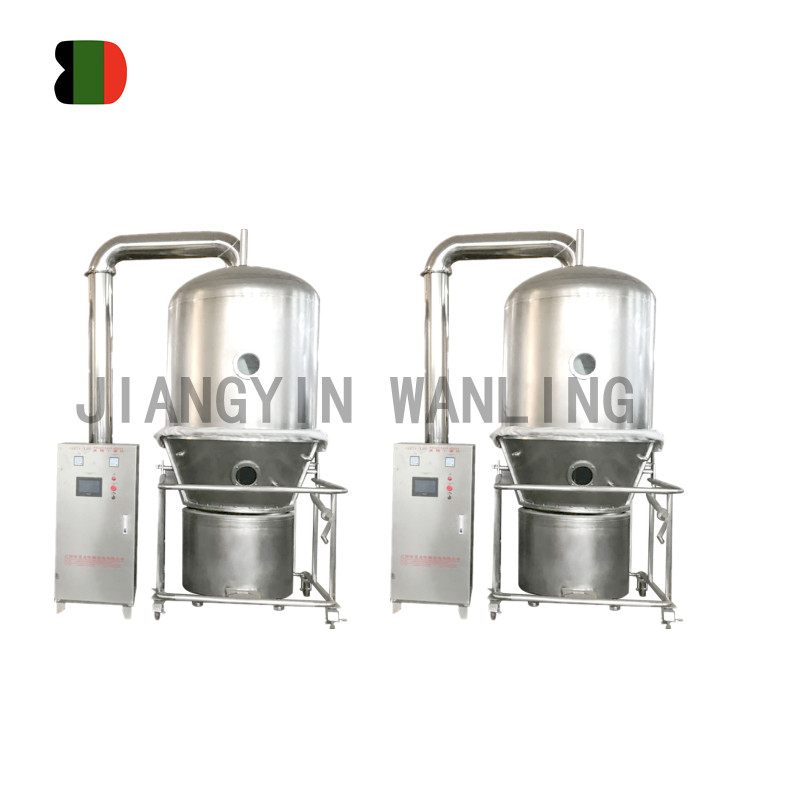
Vertical Fluidized Bed Drying Structure and Airflow Design
Vertical fluidized bed drying systems feature a vertically oriented drying chamber, allowing material to fluidize upward in a compact footprint. The air handling unit introduces filtered, heated air from the bottom plenum through a precisely engineered air distribution plate. Proper airflow distribution is essential to prevent channeling, dead zones, or uneven fluidization.
The distributor plate design directly influences fluidization quality. Hole diameter, open area ratio, and plate thickness must be selected according to particle size and density. Incorrect design may result in slugging or excessive entrainment of fine particles into the exhaust system.
Key Structural Components
- Air preparation unit with heating and filtration modules
- Perforated air distributor plate for uniform airflow
- Vertical drying chamber with expansion section
- Bag filter or cyclone separator for fine particle recovery
- Exhaust system with airflow control valves
Vertical Blending Fluidized Bed Drying Technology
Vertical blending fluidized bed drying integrates mixing and drying in a single chamber. The fluidization process naturally promotes particle blending due to constant circulation and turbulence within the bed. This configuration is especially suitable for formulations requiring homogeneous moisture distribution or simultaneous granulation and drying.
In pharmaceutical and food production, vertical blending fluidized bed drying allows uniform heat penetration and consistent moisture reduction without mechanical agitators. The absence of rotating blades reduces contamination risk and simplifies cleaning validation procedures.
Process parameters such as inlet air temperature, airflow velocity, and product load must be balanced to achieve both effective mixing and controlled drying rate. Excessive airflow may cause fine particle loss, while insufficient velocity can lead to uneven blending.
Process Control and Critical Operating Parameters
Efficient fluid bed drying depends on precise control of temperature, airflow, and residence time. Inlet air temperature determines drying capacity, while outlet air temperature reflects moisture removal progress. Modern fluid bed dryers incorporate programmable logic controllers to monitor and adjust parameters in real time.
Minimum fluidization velocity must be calculated based on particle size distribution, density, and bed height. Operating below this threshold leads to poor mixing, while operating excessively above it increases energy consumption and dust carryover.
| Parameter | Influence on Drying | Optimization Focus |
| Inlet Air Temperature | Evaporation rate | Prevent thermal degradation |
| Airflow Velocity | Fluidization stability | Avoid entrainment |
| Bed Load | Drying uniformity | Ensure balanced expansion |
Applications of Fluidized Bed Drying Systems
Fluidized bed drying systems are widely applied in industries requiring controlled moisture reduction and uniform particle quality. In pharmaceutical manufacturing, fluid bed dryers handle granules prior to tablet compression. In food processing, they dry powders, cereals, and instant products while preserving product integrity.
Chemical industries use fluid bed dryers for polymer beads, catalysts, and inorganic salts. Vertical fluidized bed drying systems are also integrated into coating and granulation lines where drying occurs immediately after spraying operations. The vertical blending fluidized bed drying configuration is particularly valuable when consistent particle mixing and moisture leveling are required within a single processing cycle.
By optimizing airflow distribution, temperature control, and chamber design, fluid bed dryers deliver efficient heat transfer, reduced drying time, and stable product quality across a wide range of industrial applications.