

 Español
Content
- 1 How to Choose the Right Ribbon Blender for Powder and Granule Mixing
- 2 Understand the material you will mix
- 3 Select shape and trough geometry
- 4 Ribbon configuration and mixing mechanism
- 5 Capacity, fill factor and mixing time
- 6 Drive, speed and power requirements
- 7 Sealing, bearings and shaft design
- 8 Discharge valves, flowability aids and outlet design
- 9 Cleaning, accessibility and sanitary options
- 10 Dust control, filtration and safety
- 11 Testing, validation and acceptance criteria
- 12 Supplier selection, warranties and after-sales support
- 13 Commercial considerations and total cost of ownership
- 14 Practical checklist to finalize selection
- 15 Final advice
How to Choose the Right Ribbon Blender for Powder and Granule Mixing
Choosing a ribbon blender for powders and granules requires matching machine design and process parameters to material characteristics, production rate and downstream requirements. This guide focuses on practical selection criteria: material behavior, blender geometry, ribbon configuration, drive and sealing options, discharge and cleaning, safety for dust-handling, acceptance testing and commercial considerations. Each section gives specific checks and decision points you can apply during vendor evaluation or internal procurement.
Understand the material you will mix
Start with a thorough characterization of the powders and granules you plan to process. Important properties to capture are bulk density, particle size distribution, true density, particle shape, cohesiveness, moisture content, flowability (e.g., Hausner ratio or Carr index), electrostatic tendency, and whether any ingredient is abrasive, hygroscopic, or fragile. These properties directly influence blender choice, fill level, mixing time, and the need for anti-agglomeration features or special discharge designs.
Key material questions to answer
- Are materials free-flowing or cohesive (tend to clump)?
- Is particle size uniform or broad? Fine dusts behave differently than coarse granules.
- Any ingredients sensitive to shear, heat, or impact?
Select shape and trough geometry
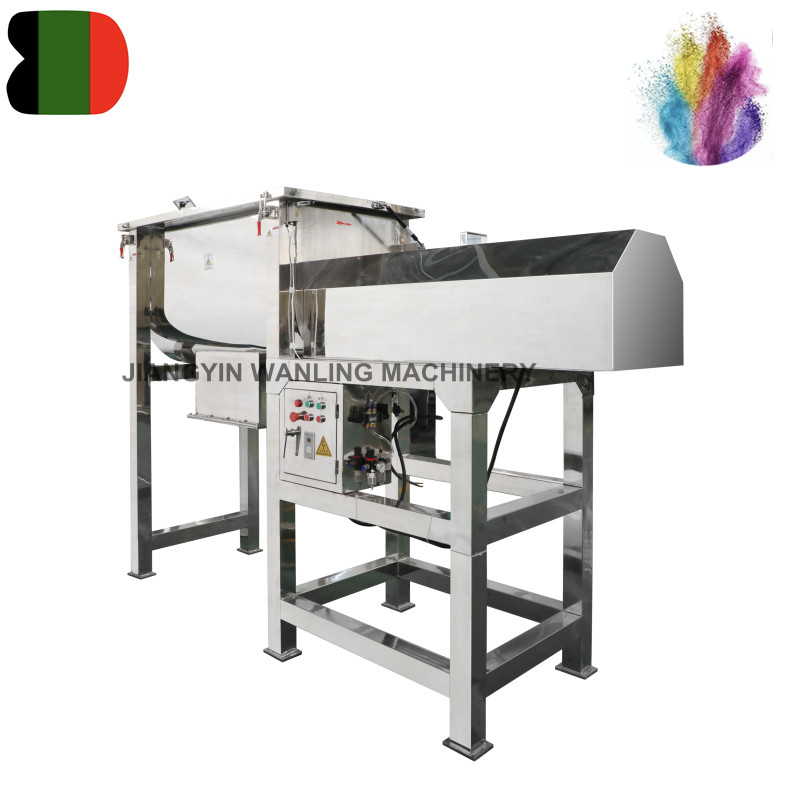
Most industrial ribbon blenders use a horizontal U-shaped trough with helical inner and outer ribbons to provide axial and radial flow. For free-flowing powders this geometry gives rapid homogeneity. For sticky or fragile materials consider modifications: deeper trough, steeper ribbon pitch, or specialized paddle-style elements. Conical or vertical blenders exist for niche needs (high shear or small batches), but horizontal ribbon blenders remain the most versatile for general powder/granule mixing.
Ribbon configuration and mixing mechanism
Ribbon design determines how materials move: the inner ribbon moves material in one direction while the outer ribbon moves it in the opposite direction, producing axial convection and gentle radial mixing. Decide between single-layer ribbons, double (counter-rotating) ribbons, or hybrid ribbon-paddle assemblies depending on material and desired intensity. For delicate products a wider, shallow-pitch ribbon reduces shear; for dense or cohesive powders a tighter pitch and deeper ribbons increase turnover.
| Feature | Standard Double-Ribbon | Single-Ribbon / Paddle Hybrid |
| Mixing style | Axial circulation with low shear | Higher shear / localized agitation |
| Best for | Free-flowing powders and bulk blends | Cohesive powders, agglomerates, wet mixes |
| Cleaning complexity | Moderate; ribbons can shadow areas | Higher; more surfaces and corners |
Capacity, fill factor and mixing time
Size the blender for your average batch but factor in fill ratio: ribbon blenders typically operate best at 40–70% of trough volume for powders to ensure efficient circulation. Oversized blenders reduce mixing efficiency and increase power consumption; undersized blenders may cause overfilling and poor homogeneity. Determine required cycle time by running lab-scale or pilot tests — mixing time depends on material properties, ribbon design and target uniformity (expressed as relative standard deviation, RSD, or coefficient of variation).
Practical sizing steps
- Define target hourly throughput and typical batch size.
- Select blender volume so expected batch weight equals 40–70% fill.
- Use pilot mixing to establish typical mixing time to reach required RSD.
Drive, speed and power requirements
Motor sizing depends on torque demand from load and friction; suppliers typically quote power at nominal speed and at locked-rotor torque. Variable frequency drives (VFD) allow speed optimization and soft start to reduce mechanical stress. For high-viscosity or damp mixes choose a drive with overload protection and a gearbox rated for peak torque. Ensure the vendor provides torque curves and locked-rotor torque data for your expected load conditions.
Sealing, bearings and shaft design
Shaft sealing prevents dust leakage and protects bearings. Options include lip seals, mechanical seals, labyrinth seals and magnetic couplings (for zero-shaft-penetration designs). For dusty or abrasive powders choose heavy-duty bearings with appropriate seals and grease purge options. For hygienic or explosive atmospheres consider seal options that meet sanitary or explosion-proof standards.
Seal and bearing checklist
- Type of seal and expected life under your material conditions.
- Bearing protection and ease of replacement.
- Availability of spare shafts, seals and bearing kits.
Discharge valves, flowability aids and outlet design
A reliable discharge system avoids bridging and ensures consistent downstream feeding. Standard butterfly or slide gate valves work for free-flowing materials. For cohesive powders specify full-discharge cone inserts, vibrator-assisted outlets, or screw feeders downstream to meter material. Consider valve actuation (manual vs pneumatic) and purge/vent options for dust control.
Cleaning, accessibility and sanitary options
If frequent changeovers or strict hygiene are required, prioritize design features that simplify cleaning: quick-open inspection doors, removable ribbon assemblies, polished internals, minimal dead zones and CIP (clean-in-place) compatibility. Sanitary finishes (Ra values, electropolish) and FDA-compliant gaskets are essential for food or pharmaceutical applications.
Dust control, filtration and safety
Powder mixing produces airborne dust. Implement dust collection, filtered vents, and proper seals. For combustible dusts perform a dust explosion risk assessment and specify equipment compliant with relevant standards (ATEX, NFPA). Consider inerting options (nitrogen purge) for reactive materials, and ensure electrical components are rated for the hazardous area classification.
Testing, validation and acceptance criteria
Define acceptance tests in the contract: sample mixing trials, homogeneity targets (e.g., RSD < specified %), coating or additive distribution tests, torque and vibration acceptance, and factory acceptance test (FAT) with witnessed operation. Require material traceability for parts in contact with product and a list of spare parts to be delivered with the machine.
Recommended FAT items
- Demonstration of mixing a representative sample load to meet homogeneity criteria.
- Verification of sealing, noise and vibration limits.
- Inspection that all welds, finishes and tolerances meet contract drawings.
Supplier selection, warranties and after-sales support
Evaluate suppliers by experience with your industry, willingness to run material trials, strength of documentation and local service presence. Check references for machines installed in similar applications. Negotiate clear warranty terms covering gearbox, shafts and seals, and confirm spare parts lead times. After-sales support including commissioning, training and preventive maintenance contracts reduces downtime risk.
Commercial considerations and total cost of ownership
Compare machines on lifecycle costs, not just capital price: energy consumption, expected maintenance intervals, spare parts costs, downtime risk, and cleaning/changeover time. A slightly higher initial cost for better seals, access or sanitary finish often pays back quickly in reduced labor, fewer rejects and longer component life.
Practical checklist to finalize selection
Use this condensed checklist when requesting quotes or evaluating proposals. It helps convert technical requirements into clear vendor questions and contract clauses.
- Material data sheet including flowability, particle size, bulk density and any special handling notes.
- Required batch size, throughput (kg/hr) and target fill ratio.
- Target homogeneity metric and acceptable mixing time.
- Coating/sanitary finish requirements, surface finish Ra or electropolish spec if applicable.
- Dust control and hazardous area classification requirements (ATEX/NFPA).
- Required FAT tests, witness trials and spare parts list.
Final advice
The best ribbon blender is the one sized and configured for your materials and production realities. Invest time in material characterization and pilot trials before committing to a full-scale purchase. Require suppliers to demonstrate performance with representative materials, provide complete technical documentation and commit to service and spare parts support. This practical approach minimizes risk and ensures consistent product quality in powder and granule mixing processes.