

 Español
Content
Introduction to Powder Ribbon Blender Mixers
Powder ribbon blender mixers are widely used in the chemical, pharmaceutical, food, and metallurgical industries to achieve uniform mixing of dry powders and granules. They are particularly valued for their ability to efficiently blend large volumes of material while maintaining homogeneity and preventing segregation.
Structural Overview and Key Components
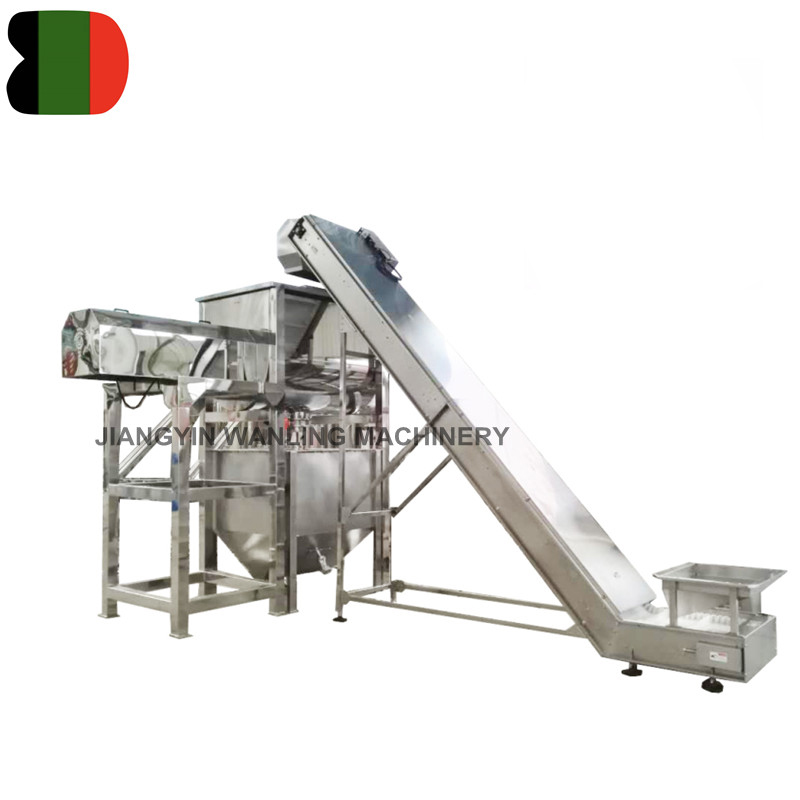
A typical powder ribbon blender consists of a U-shaped trough, a horizontally mounted ribbon agitator, and a drive mechanism. The agitator includes both inner and outer helical ribbons:
- Outer Ribbon: Moves materials outward toward the ends of the trough.
- Inner Ribbon: Moves materials inward toward the center, creating a counter-current flow.
- Drive System: Ensures uniform rotation of the ribbon assembly, typically powered by electric motors and speed reducers.
Working Principle of Powder Ribbon Blender Mixers
The ribbon blender operates based on a counter-current motion principle, which ensures thorough and consistent mixing. The mechanism involves the following steps:
Counter-Current Mixing
As the inner ribbon moves materials toward the center and the outer ribbon pushes them toward the ends, a continuous folding and shearing motion occurs. This movement allows powders to be uniformly distributed, even for materials with different particle sizes or densities.
Shear and Diffusion Effects
The blender generates both shear and diffusion, critical for breaking up agglomerates and achieving a homogeneous blend. Shear forces act along the ribbon edges, while diffusion is facilitated by the random movement of particles along the trough, enhancing uniformity.
Operational Parameters
Several factors influence mixing efficiency:
- Ribbon Speed: Higher speeds reduce mixing time but may generate heat, affecting sensitive materials.
- Fill Level: Optimal fill levels, typically 40–70% of the trough volume, ensure proper material circulation.
- Blend Time: Determined by material properties and batch size, usually ranging from a few minutes to over half an hour.
- Material Characteristics: Particle size, density, and moisture content impact blending dynamics and ribbon configuration selection.
Applications in Various Industries
Powder ribbon blenders are versatile and applied in multiple sectors for dry and granular mixing:
Pharmaceutical Industry
Used for blending active pharmaceutical ingredients (APIs) with excipients, the ribbon mixer ensures uniform dosage distribution, critical for tablet and capsule production. The gentle mixing action minimizes degradation of sensitive compounds.
Food and Beverage Industry
Commonly employed to mix flour, spices, powdered milk, and flavoring agents, powder ribbon blenders maintain homogeneity while preventing overheating, which can compromise food quality. They are also used in cocoa, coffee, and powdered beverage production for consistent taste and texture.
Chemical Industry
Ribbon blenders mix detergents, fertilizers, pigments, and polymer powders, providing uniform chemical properties and particle distribution. Their ability to handle large volumes makes them suitable for continuous and batch processing.
Metallurgical and Ceramic Applications
In powder metallurgy, the blenders mix metal powders with binders, lubricants, and alloying agents. In ceramics, powders of different compositions are blended for uniform sintering behavior. The gentle yet thorough mixing ensures product integrity and reduces defects.
Advantages and Considerations
Powder ribbon blenders offer several operational benefits, as well as important considerations for optimal performance:
Advantages
- Uniform Mixing: Counter-current motion ensures high homogeneity.
- Scalability: Suitable for small batches and large-scale industrial production.
- Low Maintenance: Simple mechanical components reduce downtime and maintenance costs.
- Versatility: Handles powders of varying particle sizes and densities efficiently.
Considerations
- Material Sensitivity: Heat generated during high-speed mixing can affect temperature-sensitive powders.
- Cleaning: Residual powders must be cleaned thoroughly to prevent cross-contamination.
- Fill Level Control: Overfilling reduces mixing efficiency, while underfilling may increase blending time.
- Sealing: Proper sealing prevents dust leakage and ensures operator safety.
Maintenance and Operational Best Practices
Regular maintenance and careful operation are essential for maximizing the lifespan and performance of a ribbon blender:
Routine Inspection
Inspect the ribbon assembly, drive system, and bearings for wear, misalignment, or damage. Replace worn parts promptly to avoid performance degradation.
Lubrication
Lubricate the drive and bearing components as per manufacturer recommendations to prevent overheating and mechanical failure.
Operational Monitoring
Monitor ribbon speed, batch fill levels, and blend time to ensure consistent mixing quality. Adjust parameters based on material properties to optimize performance.
Conclusion
The powder ribbon blender mixer is a cornerstone of dry powder processing in numerous industries. Its counter-current mixing principle, combined with adjustable operational parameters, allows for uniform, efficient, and scalable blending. Proper selection, maintenance, and operation ensure consistent quality, longer equipment life, and higher productivity, making it an indispensable tool for modern production processes.