

 Español
Automating the handling of fine powders has long been one of the most technically challenging aspects of modern manufacturing. Fine powders—whether pharmaceutical-grade active ingredients, food additives, chemical compounds, or battery materials—present unique difficulties: they are prone to dusting, segregation, clumping, electrostatic buildup, and contamination. Traditional mechanical conveying methods such as screw conveyors, belt conveyors, and manual scooping simply cannot meet the precision, hygiene, and repeatability demands of today's automated production environments. The fine powder vacuum conveyor has emerged as the definitive solution, forming the backbone of automated powder handling in industries where consistency, cleanliness, and throughput are non-negotiable.
Content
- 1 What Makes Fine Powder Vacuum Conveyors Uniquely Suited for Automation
- 2 Key Ways Fine Powder Vacuum Conveyors Drive Factory Automation
- 3 Hygiene and Containment: Enabling GMP-Compliant Automated Lines
- 4 Handling the Most Challenging Fine Powder Characteristics
- 5 Reducing Labor Dependency and Human Error
- 6 Scalability and Flexibility Across Automated Production Architectures
- 7 Real-World Industries Where Vacuum Conveyors Underpin Automation
What Makes Fine Powder Vacuum Conveyors Uniquely Suited for Automation
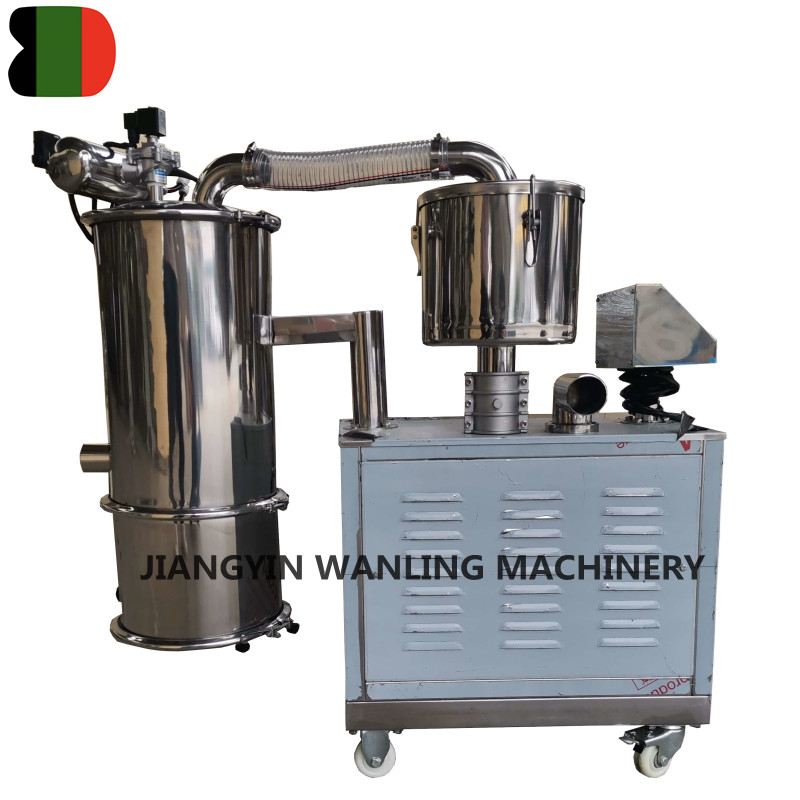
A fine powder vacuum conveyor operates by generating a controlled negative pressure environment that draws powder material through sealed tubing from a source—such as a bulk bag, drum, silo, or hopper—to a destination such as a mixer, tablet press, packaging machine, or filling station. The absence of moving mechanical parts in the conveying tube itself eliminates the shear and attrition forces that damage fragile particles or cause size segregation. This gentle, enclosed transfer mechanism makes vacuum conveyors inherently compatible with the precision requirements of automated production.
Unlike open conveying systems, vacuum conveyors are fully enclosed from intake to discharge, meaning dust never enters the working environment. This is critical for automation because airborne powder contaminates sensors, clogs actuators, reduces the lifespan of servo motors, and interferes with optical detection systems—all of which are integral components of an automated line. By eliminating dust at the source, vacuum conveyors protect the surrounding automation hardware and reduce unplanned maintenance shutdowns.
Key Ways Fine Powder Vacuum Conveyors Drive Factory Automation
Consistent, Programmable Material Flow
One of the foundational requirements of automated production is predictable, repeatable input. Fine powder vacuum conveyors can be programmed to deliver precise batch weights or volumetric flow rates by adjusting cycle times, vacuum pressure levels, and filter pulse-back intervals through a PLC or integrated controller. Modern systems routinely achieve batch accuracy within ±0.5% across thousands of consecutive cycles, which is far beyond what any manual or gravity-fed system can reliably deliver. This level of repeatability allows downstream machines—mixers, reactors, tablet presses, or filling lines—to operate at their designed parameters without operator intervention to correct feed inconsistencies.
Seamless Integration with Production Line Controls
Contemporary fine powder vacuum conveyors are designed with industrial automation communication in mind. They support standard protocols including Profibus, Profinet, EtherNet/IP, Modbus TCP, and OPC-UA, allowing them to exchange real-time data with SCADA systems, DCS platforms, and MES environments. A vacuum conveyor connected to a weighing hopper equipped with load cells can automatically trigger conveying cycles when the downstream process signals a material request—eliminating manual monitoring entirely and enabling true lights-out operation during certain production windows.
Hygiene and Containment: Enabling GMP-Compliant Automated Lines
For pharmaceutical, nutraceutical, and food manufacturers, automation is inseparable from regulatory compliance. GMP (Good Manufacturing Practice) standards require that powder handling systems prevent cross-contamination, support complete cleanability, and provide documented evidence of process control. Fine powder vacuum conveyors are engineered to meet these requirements in ways that mechanically driven systems cannot.
- Tool-free disassembly: High-specification vacuum conveyors feature quick-release clamp connections and smooth-bore internal surfaces that allow complete disassembly, cleaning, and reassembly in under 15 minutes—critical for multi-product facilities running frequent changeovers.
- Closed transfer: Powder never contacts the open environment during transfer, preventing both inward contamination and outward product loss. This is essential when handling potent active pharmaceutical ingredients (APIs) with occupational exposure limits (OELs) in the microgram range.
- Validation-ready design: Electropolished 316L stainless steel contact surfaces, FDA-compliant seals, and full material traceability documentation support IQ/OQ/PQ validation processes required in regulated manufacturing environments.
- CIP/WIP compatibility: Many automated vacuum conveyor systems now integrate clean-in-place or wash-in-place capabilities, allowing automated cleaning cycles to be triggered by the production control system between batches, with no manual intervention required.
Handling the Most Challenging Fine Powder Characteristics
Not all powders behave the same way. Fine powders—typically defined as materials with a d50 particle size below 100 microns—can exhibit a wide range of difficult flow behaviors that challenge any conveying technology. Understanding how vacuum conveyors address these challenges is essential to appreciating their role in enabling reliable automation.
| Powder Challenge | Impact on Automation | Vacuum Conveyor Solution |
| High cohesiveness / bridging | Feed interruptions, inconsistent batch weights | Vibratory or pneumatic agitation at intake point |
| High electrostatic charge | Powder adhesion to tubing walls, sensor interference | Earthed/grounded stainless components, antistatic tubing |
| Hygroscopic / moisture-sensitive | Clumping, filter blinding, quality degradation | Dry compressed air purge, sealed convey lines |
| Explosive / combustible dust | ATEX compliance requirements, ignition risk | ATEX-rated motors, bonded earthing, explosion venting |
| Abrasive particles | Rapid wear of contact components | Hardened or ceramic-lined tube bends, wear-resistant filters |
By engineering solutions to each of these powder-specific challenges directly into the conveyor design, manufacturers can build automated lines that run predictably even with difficult raw materials—without relying on operator intervention to clear blockages, adjust feed rates, or compensate for product variability.
Reducing Labor Dependency and Human Error
Perhaps the most direct way that fine powder vacuum conveyors contribute to automation is by removing the human element from powder transfer entirely. Manual powder handling—scooping from drums, pouring into hoppers, operating hand trucks—introduces significant variability, ergonomic risk, and potential for error. Workers are exposed to dust inhalation hazards, repetitive strain injuries from lifting heavy containers, and the fatigue-related inconsistencies that come with repetitive manual tasks. Each of these factors undermines the stability that automated production demands.
When a vacuum conveyor is installed to connect bulk storage directly to processing equipment, operators are no longer required to physically handle powder at any stage of the internal transfer process. A single production worker can oversee multiple conveyor-fed stations simultaneously, dramatically improving labor efficiency. In high-throughput operations such as nutraceutical capsule filling or battery electrode coating, this labor reduction translates into measurable output per head improvements and a significant reduction in product-contact errors that could trigger quality holds or batch rejections.
Scalability and Flexibility Across Automated Production Architectures
Automated production lines are not static. Products change, batch sizes vary, and process layouts evolve. Fine powder vacuum conveyor systems are inherently modular, which makes them exceptionally well-suited to scalable, flexible automation architectures.
- Multi-point transfer: A single vacuum conveying system can feed multiple downstream machines simultaneously using diverter valves and manifold arrangements, reducing the capital investment required to automate a multi-station line.
- Modular receiver units: Compact vacuum receiver heads can be mounted directly on the inlet of tablet presses, mixers, extruders, or filling machines, integrating conveying capability without requiring major structural modifications to the existing line layout.
- Variable throughput control: By adjusting vacuum level, cycle timing, and conveying line diameter, the same system can handle throughput rates ranging from a few kilograms per hour for laboratory-scale operations to several tonnes per hour in industrial bulk applications.
- Rapid product changeover: In multi-product facilities, the ability to quickly swap inlet pick-up lances between different raw material containers—combined with fast-clean convey lines—enables automated lines to switch between products with minimal downtime and cross-contamination risk.
Real-World Industries Where Vacuum Conveyors Underpin Automation
The practical impact of fine powder vacuum conveyors on automated production is most clearly visible when examining specific industry applications. In pharmaceutical solid dosage manufacturing, vacuum conveyors connect milling equipment, blenders, and tablet presses in a fully automated granulation-to-compression workflow, eliminating the intermediate container handling steps that traditionally required significant manual labor and introduced contamination risk at every transfer point.
In lithium-ion battery production, where electrode powders such as lithium iron phosphate, graphite, and NMC must be handled with extreme precision and zero moisture exposure, vacuum conveyors operating within nitrogen-blanketed enclosures allow fully automated electrode slurry preparation lines to function with the consistency demanded by strict cell performance specifications. Even minor variations in powder input can affect energy density and cycle life, making the repeatable, enclosed transfer of vacuum conveying indispensable.
In food and dairy processing, fine powder vacuum conveyors automate the transfer of ingredients such as milk powder, cocoa, starch, and sugar from bulk storage silos directly into continuous mixing and forming lines. The hygienic design ensures compliance with food safety standards while the programmable batch control supports the precise recipe management that consistent product quality requires. Across all of these sectors, the common thread is clear: fine powder vacuum conveyors do not merely assist automation—they make true, reliable automation of powder handling processes achievable in the first place.