

 Español
Content
Introduction to Double Cone Blenders
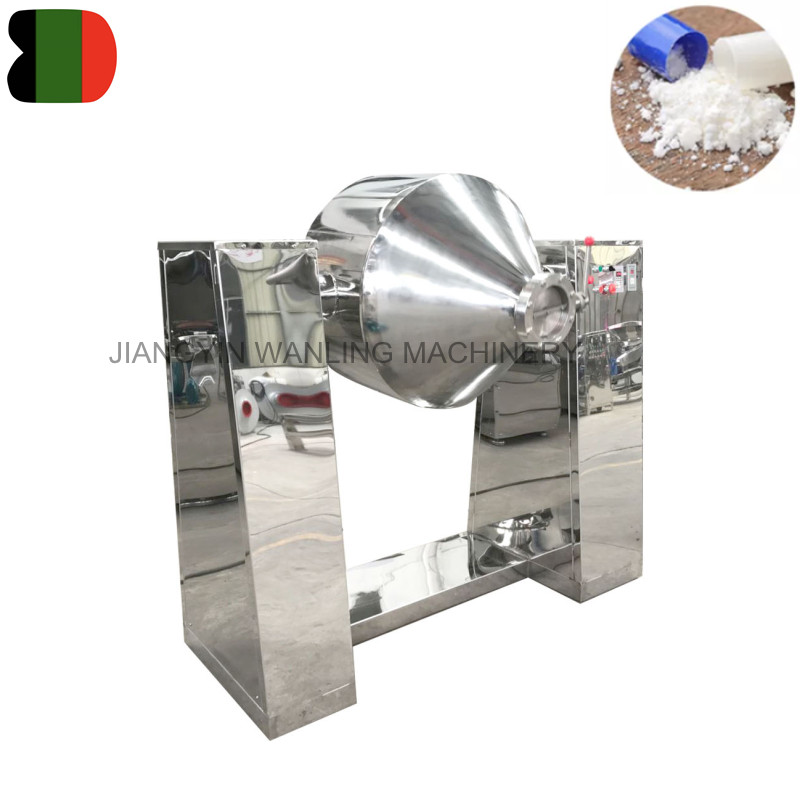
Double cone blenders are widely used industrial mixing machines designed to achieve uniform blending of powders and granular materials. Their unique design, featuring a rotating double-cone vessel, ensures continuous tumbling and even distribution of particles. While they are primarily associated with dry blending, modern double cone blenders are also capable of handling certain wet blending processes with appropriate modifications.
Understanding the differences between dry and wet blending capabilities is crucial for selecting the right process parameters, optimizing efficiency, and ensuring product quality in pharmaceutical, chemical, and food industries.
Dry Blending in Double Cone Blenders
Dry blending is the most common application for double cone blenders. It involves mixing powders or granular materials without the addition of liquids. The tumbling action of the double-cone vessel causes materials to flow and cascade, promoting uniform mixing and minimizing the risk of segregation.
Key advantages of dry blending include energy efficiency, reduced contamination risk, and minimal equipment wear. Dry blending is particularly suitable for materials sensitive to moisture, such as pharmaceuticals, chemical powders, and certain food ingredients.
Factors Affecting Dry Blending Efficiency
- Particle size distribution: Uniform particle sizes promote faster and more consistent mixing.
- Bulk density differences: Materials with large density variations may require additional blending time or auxiliary equipment.
- Rotation speed: Proper rotational speed ensures adequate tumbling without material sticking to the vessel walls.
Wet Blending in Double Cone Blenders
Wet blending in double cone blenders involves the addition of liquids or binders to powders or granular materials. This process is less common and requires careful consideration of equipment modifications, such as the use of liquid injection systems or internal baffles to improve dispersion.
Wet blending is used in applications where a uniform coating of liquid is required, or when forming granules and pastes for pharmaceutical tablets, chemical compounds, or food products. The key challenge is to prevent clumping, sticking, or uneven distribution of the liquid within the blend.
Factors Affecting Wet Blending Efficiency
- Viscosity of the liquid: High-viscosity liquids may require slower rotation or additional mixing mechanisms.
- Powder absorption capacity: Materials that absorb liquid quickly may affect blend uniformity.
- Moisture sensitivity: Certain powders may degrade or react when exposed to liquids, limiting wet blending applications.
Comparing Dry and Wet Blending Capabilities
Understanding the differences between dry and wet blending in double cone blenders helps optimize process selection and equipment usage. Both processes rely on the tumbling action of the double-cone vessel, but wet blending introduces additional challenges related to liquid dispersion and material behavior.
| Aspect | Dry Blending | Wet Blending |
| Material Type | Powders and granules without liquids | Powders combined with liquids or binders |
| Equipment Modifications | Standard double-cone vessel | May require baffles, liquid injection systems, or special coatings |
| Process Complexity | Simple, low maintenance | Higher complexity due to liquid handling and dispersion |
| Common Applications | Pharmaceutical powders, chemical granules, food ingredients | Tablet granulation, coated powders, wet chemical compounds |
Conclusion
Double cone blenders offer flexible capabilities for both dry and wet blending, though dry blending remains the primary application due to its simplicity and efficiency. Wet blending is feasible for specific processes, but requires careful attention to liquid properties, material behavior, and equipment modifications. Selecting the appropriate blending method ensures consistent product quality, operational efficiency, and optimal performance in pharmaceutical, chemical, and food manufacturing.