

 Español
Content
- 1 A pharmaceutical line expansion fails within six months—not because of the granulator’s price, but because the bowl seals leaked, end-point control drifted, and the manufacturer’s after-sales response took weeks. Choosing the right China rapid mixer granulator manufacturers means evaluating far more than a spec sheet.
- 2 What separates a high-performance rapid mixer granulator from a commodity mixer
- 3 Critical evaluation criteria for China rapid mixer granulator manufacturers
- 4 Comparing rapid mixer granulator offerings across the market
- 5 Sourcing from a manufacturer that understands the full solid dose line
- 6 Reducing risk through factory audits and trial runs
A pharmaceutical line expansion fails within six months—not because of the granulator’s price, but because the bowl seals leaked, end-point control drifted, and the manufacturer’s after-sales response took weeks. Choosing the right China rapid mixer granulator manufacturers means evaluating far more than a spec sheet.
The single largest cost of a rapid mixer granulator (RMG) is rarely the initial purchase. It is the cumulative downtime, inconsistent granule quality, and batch rejections that follow a poorly vetted equipment choice. When sourcing from China rapid mixer granulator manufacturers, production directors and procurement teams must shift their focus from capital expenditure to the total cost of ownership, which hinges on mechanical robustness, process control maturity, and the supplier’s ability to support validation and spare parts logistics far from its home market.
What separates a high-performance rapid mixer granulator from a commodity mixer
An RMG combines dry powder mixing, liquid binder addition, and high-shear wet massing in a single enclosed bowl. The impeller creates a vortex for dispersion while the high-speed chopper breaks agglomerates and distributes binder uniformly. Inconsistent blade clearance, suboptimal impeller geometry, or poorly sealed discharge ports lead directly to granule size variation and undermixed fines.
For solid dose manufacturing, the following engineering attributes define whether a machine can deliver repeatable results across years of continuous operation:
- Bowl and impeller construction in pharmaceutical-grade stainless steel (316L for contact parts) with surface finishes below 0.4 µm Ra to minimize adhesion and ease cleaning.
- Double mechanical seals on both impeller and chopper shafts, with leak detection for containment of high-potency compounds.
- Displacement-type discharge valves that close flush with the bowl wall, eliminating dead zones that retain material and cause cross-batch contamination.
- Variable-frequency drives enabling precise impeller and chopper speed ramps, critical for endpoint control based on power consumption or torque monitoring.
Many China rapid mixer granulator manufacturers now offer these features as standard, but execution varies widely. The difference lies in the tolerances maintained during fabrication and the availability of documentation to prove them.
Critical evaluation criteria for China rapid mixer granulator manufacturers
Construction materials and fabrication integrity
Specifying a 316L wetted surface is a minimum; verifying that the manufacturer uses certified, traceable stainless steel is what protects your investment. Request material certificates for all product-contact components. Mirror-polished internal surfaces must be free of pinholes or grinding marks that trap product. For pharmaceutical buyers, any deviation from cGMP-compatible welds and sanitary ferrule connections must trigger an immediate audit finding.
Process control and instrumentation
A reliable RMG should record impeller speed, chopper speed, product temperature, and power draw with a sampling rate fast enough to detect an endpoint within seconds. Look for manufacturers that integrate load cells for binder addition and provide trend displays of power-to-time curves. Batch records must be exportable and compliant with 21 CFR Part 11 requirements when used in regulated environments.
Validation and documentation support
Insist on China rapid mixer granulator manufacturers that supply a complete design qualification (DQ), installation qualification (IQ), operational qualification (OQ), and a template performance qualification (PQ) protocol. Without these, your own validation effort multiplies in cost and duration. Verify that the supplier can deliver factory acceptance testing (FAT) reports with full instrument calibration data before shipment.
After-sales service and spare parts availability
Overseas customers often struggle with the gap between a manufacturer’s sales promises and the reality of post-installation support. Request a written agreement for spare parts inventory held at the factory, guaranteed response times for technical inquiries, and remote video-assisted troubleshooting. A manufacturer that serves multiple industries—pharma, food, chemical—often maintains a broader and more resilient parts supply chain.
Comparing rapid mixer granulator offerings across the market
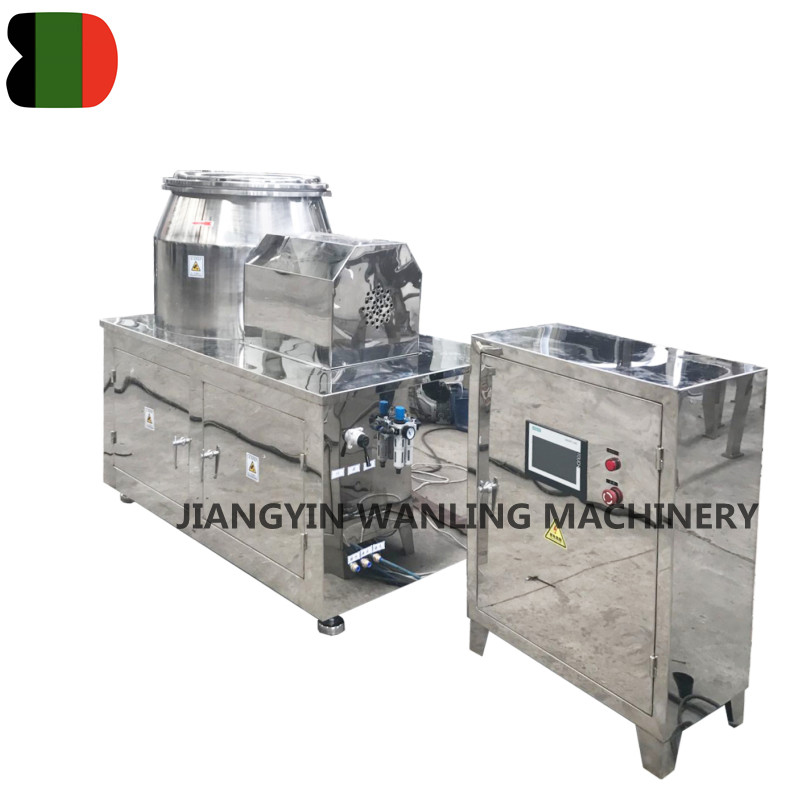
While machine capacities range from 5-litre lab units to 1,200-litre production workhorses, pharmaceutical granulation typically clusters in the 100‑600 litre working capacity band. The table below lists the performance envelope that a well-engineered Chinese RMG should deliver.
| Parameter | Expected Range | Significance |
|---|---|---|
| Total bowl volume | 120–150 L | Ensures sufficient headspace for proper vortex mixing |
| Impeller speed | 50–300 rpm | Controls shear input and granule density |
| Chopper speed | 1,500–3,000 rpm | Fine-tunes granule uniformity and binder distribution |
| Typical granulation time | 3–12 minutes | Reflects efficient binder uptake and reduces API exposure to heat |
| End-point indication | Power consumption or torque curve plateau | Enables reproducible granule characteristics batch to batch |
| Discharge port seal | Inflatable silicone or PTFE seals | Prevents binder seepage and cross-contamination |
When a Chinese manufacturer’s standard configuration already meets this envelope and the provider offers process trials with your actual formulation, the risk of commissioning failure drops significantly.
Sourcing from a manufacturer that understands the full solid dose line
Companies that produce a range of upstream and downstream equipment often engineer their RMG models to integrate seamlessly with fluid bed dryers, cone mills, and tablet presses. Jiangyin Wanling International Trading operates its own factory in Jiangyin, a city near Shanghai with strong export logistics. The facility manufactures high-shear mixing granulators under the rapid mixer granulator category, alongside grinding, drying, mixing, and tableting machines for the pharmaceutical, food, chemical, and spice sectors.
For a production manager planning a new granulation suite, the advantage lies in a single supplier providing mechanical compatibility across the entire train. The factory’s focus on stainless steel construction, automated controls, and international documentation aligns with the selection criteria outlined above. Engaging early with the manufacturer for a trial batch using your product can surface process-specific adjustments before equipment leaves the factory floor.
Reducing risk through factory audits and trial runs
No amount of marketing material replaces a physical or remote audit of the welding shop, surface finishing stations, and testing procedures. When working with China rapid mixer granulator manufacturers, schedule a comprehensive review of in-process quality records, not just the final certificate. Request a trial granulation run with your own excipient blend and binder solution; have the manufacturer video-record the entire process and ship samples to your lab for sieve analysis and moisture content verification.
A partner that stands behind its process performance will not hesitate to provide these data. The small upfront cost of a trial run is negligible compared to the downstream expense of process validation failures, batch losses, or regulatory observations. In pharmaceutical solid dose manufacturing, a few weeks spent evaluating a potential RMG supplier is one of the most consequential investments a team can make.