

 Español
If the outlet of your grinder sits at floor level and the inlet of your mixer or packaging machine waits three metres above it, the vertical link between those two points decides whether your line holds its rated throughput or loses product to spillage and breakage. For free-flowing powders and granules, a bucket elevator conveyor is usually the most economical and material-friendly way to make that lift, and it stays gentle enough for fragile loads such as puffed grains, dried chilli pieces, or freshly granulated pharmaceutical powder. The conclusion comes with conditions, though: sticky, wet, or highly aerated fine powders generally perform better in a screw or vacuum conveyor, and specifying the wrong discharge style is one of the most common and expensive mistakes buyers make. The sections below explain how these machines work, where they beat the alternatives, and what to verify before you sign a purchase order.
Content
How a Bucket Elevator Conveyor Works
A bucket elevator conveyor carries bulk material vertically inside an enclosed casing on buckets fixed to a belt or chain that loops around a head pulley at the top and a tail pulley at the bottom. Material enters the boot section at the base, either scooped up by the passing buckets or fed in through a chute, rides upward, and leaves at the head, where the discharge style determines how cleanly it separates from the bucket.
Centrifugal Discharge for Speed
Centrifugal-discharge designs space the buckets apart and run them faster, commonly somewhere between about 1.2 and 1.8 metres per second on a belt. As each bucket rounds the head pulley, centrifugal force throws the load clear into the discharge chute. This is the workhorse configuration for free-flowing products such as sugar, salt, grains, sesame seed, and whole peppercorns, and it delivers the highest throughput per unit of casing size.
Continuous Discharge for Fragile Products
Continuous-discharge designs mount buckets back to back and run slower. At the head, the load slides gently over the back of the bucket ahead of it instead of being flung clear, so it exits with minimal impact. Throughput per bucket is lower, but breakage drops sharply, which matters for coated granules, extruded pellets, tea leaves, and any product where extra fines create rework or dust problems downstream.
Belt or Chain Drive
Both styles run on either a belt or a chain. Belt-driven units are quieter, travel faster, and suit food and pharmaceutical environments where routine washdown is expected. Chain-driven units take heavier, hotter, or more abrasive loads, such as hot chemical prills. Most food, spice, and pharmaceutical plants lift material somewhere between 2 and 12 metres, a range either drive type covers comfortably.
Where a Bucket Elevator Fits Best
Bulk density, flowability, and particle integrity decide fit better than industry labels do. Bucket elevators reward materials that pour predictably and survive contact with a steel bucket: seeds, grains, pellets, prills, and granulated powders. In food production and spice processing plants, that covers whole spices, coffee beans, sugar, salt, and many blend components. Pharmaceutical lines use them to carry granules from the granulator up to the sifter or tablet press, where a continuous-discharge head protects granule integrity before compression. Chemical processors move catalyst pellets, detergent granules, and fertilizer prills the same way.
Construction details follow the industry. Food and pharmaceutical buyers should specify stainless steel contact parts, with 304 as the general standard and 316 where salt, acids, or aggressive cleaning chemicals appear, along with crevice-free welds and a dust-tight casing. One caution deserves emphasis: fine organic powders such as flour-fine pepper or powdered sugar can form combustible dust clouds, so any elevator handling them needs grounded components, tight seals, and, on larger installations, explosion venting sized by a proper risk assessment.
Not every material qualifies. Sticky or oil-rich products build up in the boot, wet pastes belong in a pump line rather than a bucket, and highly aerated powders can flood the discharge. Screening these cases out at the quotation stage costs nothing; discovering them during commissioning costs a production delay.
How It Compares With Other Conveying Options
When a bucket elevator is the wrong call, one of three alternatives usually takes its place, and each wins in different territory.
Fine powders, including ground spices, flour, and pharmaceutical powders, transfer best in a sealed vacuum conveyor, which draws material through stainless tubing in batches. The product touches only tube and filter, the plant stays dust-free, and cleaning comes down to swapping a filter cartridge instead of washing a bucket-and-belt assembly. For closed powder transfer across one or two floors, our ZKS stainless steel food powder vacuum conveyor is a typical fit.
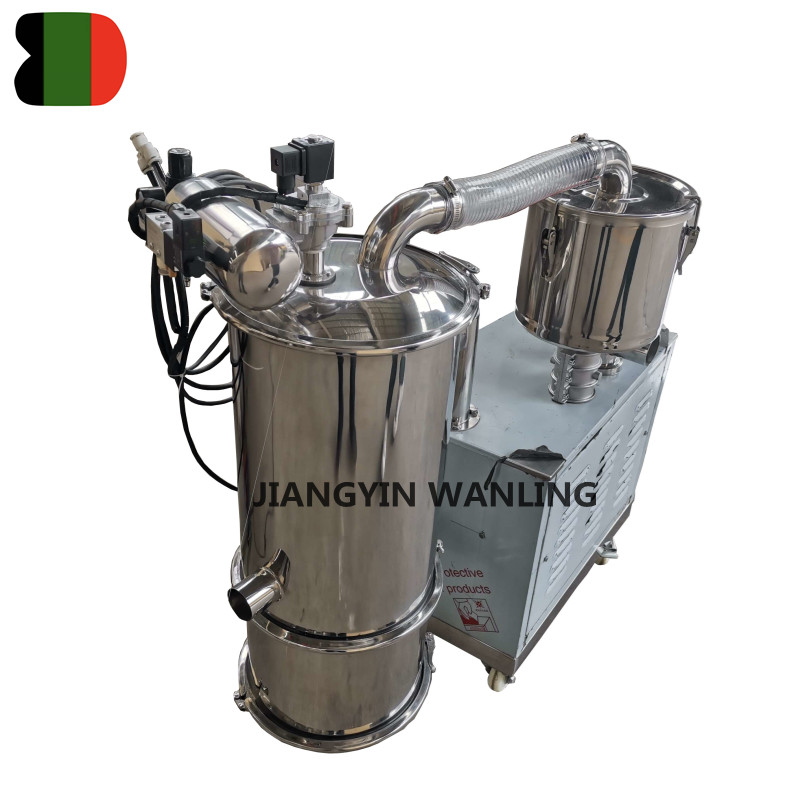 ZKS Stainless Steel Food Powder Vacuum ConveyorThis sealed vacuum conveyor moves fine food and pharmaceutical powders through stainless tubing in batches, keeping the plant dust-free. With up to 6000 kg/h at 10 meters, it suits closed powder transfer across one or two floors.View Product →
For horizontal and moderately inclined runs, a screw conveyor remains the budget answer. It is simple and inexpensive, but material rubs along the trough for the entire journey, so fragile granules chip and abrasive blends wear the flight. Capacity also falls away sharply as the incline steepens past roughly 30 degrees, which is precisely where bucket elevators take over. An LS food granule screw conveyor, for example, is best reserved for level or gently inclined transfers of robust granules and seeds.
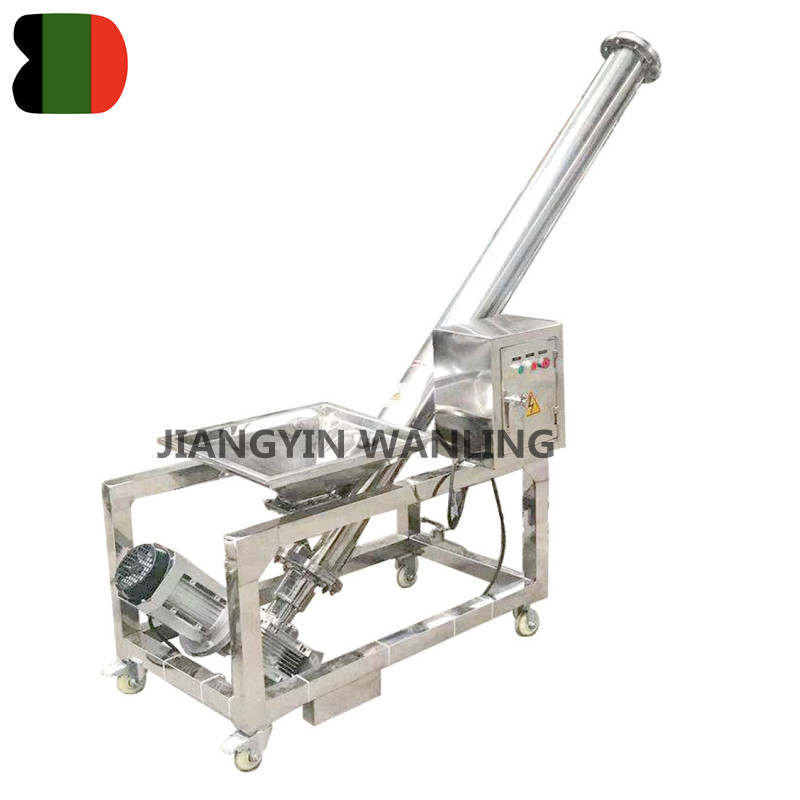 LS Food Granule Screw ConveyorA stainless steel screw conveyor for dry powders and small granule batches, offered as the economical option for level or gently inclined runs, since capacity drops sharply on steeper slopes.View Product →
| Conveyor type | Best-suited materials | Typical duty | Main trade-off |
|---|---|---|---|
| Bucket elevator | Free-flowing granules, pellets, seeds, grains | Vertical lifts of roughly 2 to 30 m | Gentle and space-efficient, but more surfaces to clean and a boot section that needs correct feeding |
| Screw conveyor | Powders and small granules | Horizontal to roughly a 30 to 45 degree incline | Low cost and simple, but higher product contact and wear on inclined runs |
| Vacuum conveyor | Fine and medium powders | Enclosed vertical and horizontal paths in batches | Dust-free and hygienic, but lift per unit is limited and filters need routine service |
| Belt conveyor | Granules, chunks, whole fruit and vegetables | Horizontal runs and gentle inclines | Very gentle with high capacity, but occupies floor space and struggles above shallow angles without cleats |
Matched to the right duty, each option earns its place: belts for gentle horizontal feeding, screws for economical short moves, vacuum systems for enclosed powder transfer, and buckets for the vertical lift itself.
What to Check Before You Buy
Most bucket elevator disappointments trace back to a handful of inputs given incorrectly at the quotation stage, so put these points on your checklist before comparing prices.
- Bulk density in kilograms per cubic metre: bucket size and speed are calculated from it, and a 20 percent error can shift real capacity by a similar margin.
- Required throughput at the tightest point of the line, not the average, so the elevator never becomes the bottleneck during peak demand.
- Discharge height and outlet position, measured to the mating chute rather than to the casing, so the head section lines up with the equipment above it.
- Hygienic details for food and pharmaceutical use: quick-release buckets, polished welds, washdown-rated seals, and the correct stainless grade for the product.
- Dust and safety provisions, including static grounding, interlocked inspection doors, and explosion venting where the material demands it.
- Wear parts availability: spare buckets, belt or chain, and bearings, because a snapped belt can idle the whole line until a replacement arrives.
Wherever possible, ask the supplier to run a trial with a sample of your actual material. A short test reveals boot carryback, discharge carryover, and product degradation that no datasheet will show, and it costs far less than discovering those issues after installation.
Installation and Maintenance Essentials
A bucket elevator is mechanically simple, which is exactly why small neglected details grow into expensive failures. A few habits keep one running for years.
- Check belt or chain tension monthly and re-tension as soon as tracking drifts, because a slipping or wandering belt chews buckets and stretches itself further.
- Inspect buckets weekly during the first months of operation and then on a fixed schedule, tightening bolts and replacing cracked buckets before they shear off into the product.
- Watch the boot section for spillage and buildup, the two earliest symptoms of a wrong feed rate, worn buckets, or a misaligned discharge.
- Keep the head pulley and drive guards in place, and never clear a jam while the drive is energized; the stored tension in a loaded belt causes serious injuries every year.
- Lubricate bearings on the interval the manual specifies, and give sealed-for-life bearings a periodic temperature check, since heat is the first visible sign of failure.
Seen as a standalone machine, a bucket elevator is a steel box with buckets in it. Seen as part of a processing line, it is the vertical spine that lets a grinder feed a mixer, a mixer feed a sifter, and a sifter feed a packaging machine without an operator hauling loads up a staircase. Our own range covers the rest of that journey: the belt conveyor for fruit and bulk material that feeds the front of the line, enclosed vacuum and screw options for powders, plus grinding, mixing, drying, granulating, and packaging equipment for spice, pharmaceutical, chemical, and food plants. If you send us your material, its bulk density, and the lift height you need through our contact page, we will tell you plainly whether a bucket elevator, a vacuum conveyor, or a screw conveyor is the option that actually pays off on your line.
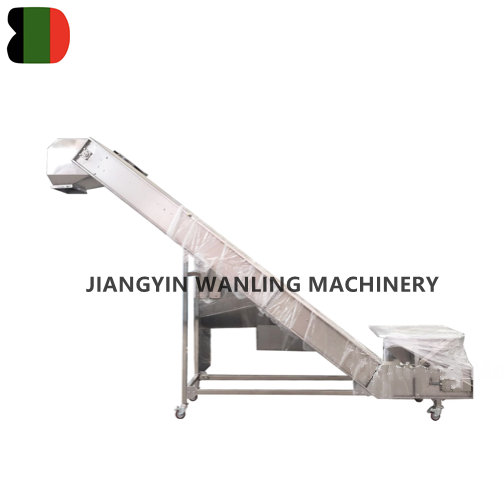 Fruit Big Material Belt ConveyorA stainless steel belt conveyor for fruit and bulk material, used to feed the front of processing and packaging lines gently, completing the conveying range alongside vacuum, screw, and bucket options.View Product →