

 Español
Content
Introduction to High Efficient Fluidized Dryers
A High Efficient Fluidized Dryer (also known as a fluid bed dryer) is a sophisticated industrial drying machine that uses a stream of heated air to suspend, agitate, and dry particulate materials simultaneously. Unlike conventional tray or rotary dryers, this equipment achieves drying by creating a fluidized state in which solid particles behave almost like a liquid, enabling uniform heat and mass transfer throughout the entire batch. This technology has become indispensable across a wide range of industries due to its exceptional efficiency, speed, and product quality outcomes.
The core mechanism involves forcing conditioned air through a perforated distribution plate at the bottom of the drying chamber. This upward airflow lifts the material particles, causing them to float and circulate within the chamber. The constant motion ensures every particle is exposed to the drying air, eliminating cold or wet spots and dramatically reducing processing time compared to static drying methods.
Key Uses of High Efficient Fluidized Dryers
High Efficient Fluidized Dryers are deployed across numerous industrial sectors where precise, rapid, and contamination-free drying is critical. Their versatility makes them a preferred choice for manufacturers who require consistent output quality and high throughput.
Pharmaceutical Manufacturing
In the pharmaceutical industry, fluidized dryers are essential for drying granules after wet granulation — a step critical to tablet and capsule production. The equipment ensures that active pharmaceutical ingredients (APIs) are dried to precise moisture levels without degradation. It is also used for coating pellets with functional polymers, enabling controlled-release drug formulations. Regulatory compliance is supported by closed, GMP-standard designs that prevent cross-contamination and allow for complete cleaning validation.
Food Processing
Food manufacturers use high efficient fluidized dryers to process a wide variety of products including sugar, salt, spices, milk powder, instant coffee, starch, and breakfast cereals. The gentle fluidization action preserves the flavor, color, nutritional content, and structural integrity of sensitive food ingredients. Continuous operation modes allow large-scale production lines to achieve consistent moisture content for extended shelf life and stable packaging performance.
Chemical and Agrochemical Production
Chemical manufacturers rely on fluidized dryers to process fertilizers, pesticides, pigments, catalysts, and fine chemical powders. The ability to handle heat-sensitive or explosive materials using inert gas circulation (closed-loop systems) makes this equipment especially valuable in the chemical industry. Agrochemical companies benefit from the dryer's ability to process granular fertilizers while maintaining uniform particle size distribution and flowability.
Mineral and Mining Applications
In mineral processing, high efficient fluidized dryers are used to reduce the moisture content of ores, silica sand, calcium carbonate, and other mineral powders. Proper drying ensures downstream processes such as milling, classification, and packing run efficiently without clogging or quality variation. The dryer's scalability and energy recovery options make it cost-effective even for large-volume mineral operations.
Core Functions and Working Principles
Understanding what a High Efficient Fluidized Dryer does requires examining its primary technical functions, each of which contributes to its superior performance compared to conventional drying alternatives.
Moisture Removal
The primary function of the fluidized dryer is the removal of surface and internal moisture from solid particles. Heated, dehumidified air enters from below the product bed, contacts every suspended particle, absorbs moisture, and exits through the top filter section. Because every particle is individually surrounded by drying air, the moisture evaporation rate is far higher than in static dryers where only surface layers are exposed to airflow. This results in drying cycles that are often 30–60% shorter than tray drying processes.
Granule Coating and Layering
Advanced fluid bed systems include spray nozzles that allow simultaneous drying and coating. Binders, coatings, or active agents can be sprayed onto fluidized particles while drying air prevents agglomeration. This multi-function capability is particularly valuable in pharmaceutical pellet coating and the production of encapsulated food ingredients, combining two manufacturing steps into one operation to save time and cost.
Agglomeration Control
Some fluidized dryer configurations are designed to intentionally promote agglomeration — the controlled bonding of fine particles into larger, more uniform granules. This is particularly useful when producing instant powders that require good dispersibility in water. By carefully managing air velocity, temperature, and binder spray rate, operators can produce granules with specific bulk density, porosity, and dissolution profiles tailored to end-product requirements.
Cooling After Drying
Many high efficient fluidized dryers include a cooling zone or can be switched to operate with ambient or chilled air after the drying phase. This integrated cooling function reduces the product temperature to safe levels for immediate packaging, eliminating the need for separate cooling conveyors or trays and further reducing the overall processing footprint and time.
Performance Advantages Over Conventional Dryers
The high efficiency of fluidized dryers is not merely a marketing claim — it is supported by specific technical and operational advantages that translate directly into measurable production benefits.
| Feature | Fluidized Dryer | Tray / Oven Dryer |
| Drying Speed | Very Fast (minutes to 1–2 hrs) | Slow (4–24 hrs) |
| Moisture Uniformity | Highly Uniform | Variable |
| Labor Requirement | Low (automated) | High (manual loading) |
| Product Contamination Risk | Low (closed system) | Higher (open trays) |
| Energy Efficiency | High (heat recovery options) | Moderate |
| Scalability | Batch and Continuous | Batch Only |
Critical Design Features That Drive Efficiency
The exceptional performance of modern high efficient fluidized dryers is the result of carefully engineered design elements that work together to optimize airflow, heat transfer, and product handling.
- Perforated Distribution Plate: Precisely engineered air distribution plates ensure uniform fluidization across the entire product bed, preventing dead zones or channeling that would lead to uneven drying.
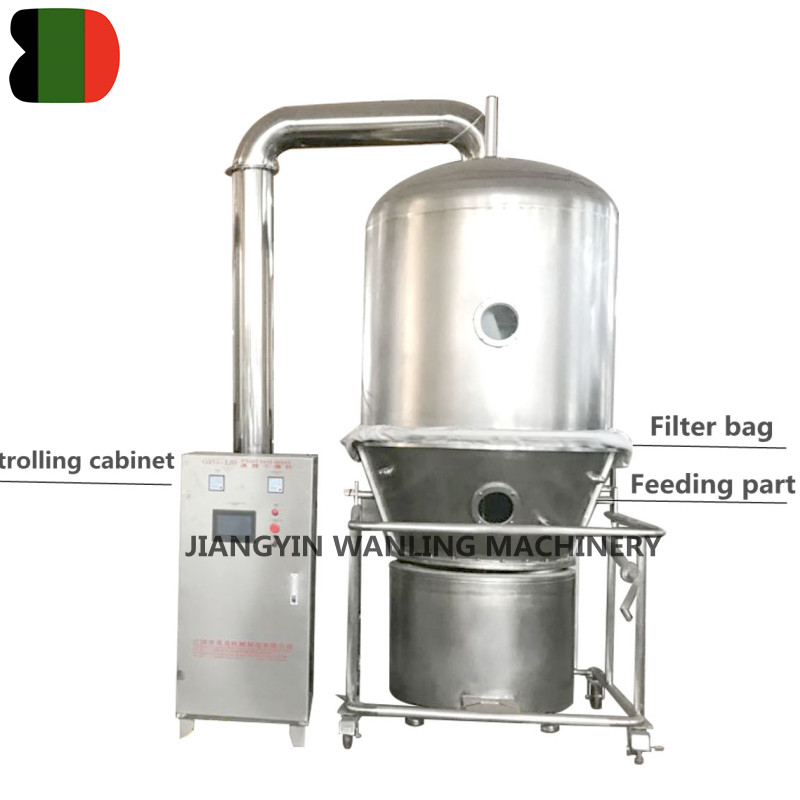
- Inlet Air Handling Unit (AHU): The AHU filters, heats, and dehumidifies incoming air to precise temperature and humidity specifications, ensuring repeatable drying conditions regardless of ambient weather variations.
- Bag Filter System: An integrated bag or cartridge filter system at the exhaust captures fine dust and product fines, preventing product loss and maintaining environmental compliance without requiring external dust collectors.
- PLC Control System: Programmable logic controllers allow operators to set, monitor, and record drying parameters including inlet temperature, outlet temperature, air velocity, and batch time — essential for regulatory documentation in pharmaceutical environments.
- Explosion-Proof Options: For flammable or explosive materials, the dryer can be configured with anti-static components, nitrogen purging, and pressure relief panels to ensure safe operation.
Selecting the Right Fluidized Dryer Configuration
High Efficient Fluidized Dryers come in batch and continuous configurations, and selecting the right design depends on production volume, material characteristics, and process requirements.
Batch fluid bed dryers are ideal for pharmaceutical granule drying, multi-product facilities, and operations requiring strict batch traceability. They offer flexibility for frequent product changeovers and smaller production volumes while maintaining full GMP compliance.
Continuous fluid bed dryers are better suited for high-volume food, chemical, and mineral applications where a steady product feed is available. They can be integrated directly into upstream and downstream processes such as granulators, coolers, and packaging lines, enabling fully automated production without manual intervention between stages.
Key material parameters to consider when specifying a fluidized dryer include particle size and size distribution, bulk density, moisture content, heat sensitivity, abrasiveness, and whether the material is prone to electrostatic buildup. A thorough characterization of the product ensures the selected dryer configuration will deliver the required outlet moisture, particle integrity, and throughput rate within the specified energy consumption envelope.
Conclusion
The High Efficient Fluidized Dryer represents one of the most versatile and effective drying technologies available to modern manufacturers. Its ability to uniformly dry, coat, granulate, and cool particulate materials in a single, enclosed system makes it indispensable across the pharmaceutical, food, chemical, and mineral industries. By combining rapid moisture removal, precise process control, low contamination risk, and energy-efficient operation, these dryers deliver consistent product quality at lower operational costs compared to conventional alternatives. Whether deployed as a batch system for regulated pharmaceutical production or as a continuous unit in a high-output food processing plant, the high efficient fluidized dryer remains a cornerstone of advanced industrial processing technology.