

 Español
A food plant was losing nearly 4 percent of every batch as dust and broken granules during transfer from the mixer to the packing line. The problem was not the mixing step; it was a dilute phase conveying line running at 22 m/s, letting every particle strike the pipe wall and every bend. After converting to dense phase pneumatic conveying, product loss fell below 0.5 percent and pipe life extended from about one year to more than four. That outcome is typical for materials that are abrasive, friable, or prone to segregation: dense phase moves the same bulk solids at a fraction of the velocity, so particles slide through the line in packed slugs instead of colliding with fittings at high speed.
Content
What Is Dense Phase Pneumatic Conveying?
Dense phase pneumatic conveying is a low-velocity, high-pressure method of moving bulk powders and granules. The material is not suspended in the air stream. Instead, a compressor or blower delivers air at roughly 2 to 8 bar (30 to 100 PSIG), pushing a packed column of product through the pipeline. The material travels as dunes along the bottom of the pipe or as full-bore slugs separated by air pockets.
The conveying density in the line is typically around 50 percent of the material's bulk density at rest, which is why the method is called "dense." Product velocities usually stay between 1 and 8 m/s, compared with 15 to 35 m/s for dilute phase conveying. This combination of high pressure and low velocity is what protects both the product and the pipe.
Dense Phase vs. Dilute Phase: What Actually Changes
The simplest way to compare the two methods is by how the product moves. In dilute phase, material is fully suspended and follows the air stream, so individual particles travel quickly and collide with the pipe wall. In dense phase, material is pushed forward as slowly moving plugs, and most of the air's energy is converted into pressure rather than velocity.
| Parameter | Dilute Phase | Dense Phase |
|---|---|---|
| Product velocity | 15-35 m/s | 1-8 m/s |
| Air pressure | 0.2-1 bar | 2-8 bar |
| Product-to-air ratio | Low | High |
| Component wear | High | Low |
| Product degradation | High | Low |
| Air compression cost | Lower | Higher |
| Typical conveying distance | Short to medium | Medium to long |
The higher air compression cost is the main reason dense phase is not installed everywhere. The savings come from reduced wear, less product damage, and lower maintenance on bends, diverters, and rotary valves.
How a Dense Phase System Works
A dense phase system has three core elements: a pressure vessel or blow tank that feeds material into the line, a compressed air supply, and air injection points along the pipeline. The operating cycle is straightforward:
- The blow tank is filled while vented to atmosphere.
- The inlet valve closes and compressed air pressurizes the vessel.
- When vessel pressure overcomes pipeline resistance, material is forced out of the tank into the line.
- Air injection points along the pipe release air at intervals, keeping the material column moving as plugs and preventing it from packing solid.
One point that still causes confusion is the difference between a blow tank and true dense phase operation. Using a blow tank alone does not guarantee dense phase behavior. If the air velocity is high enough to suspend the material, the system operates in dilute phase even though it is fed by a pressure vessel. The deciding factor is velocity, not the feeder type.
Which Materials Benefit Most
Dense phase is not the right choice for every product. It earns its operating cost on materials that would otherwise be damaged or would damage the line. Four categories are especially well suited:
- Abrasive products such as alumina, silica sand, and many chemical intermediates. Low velocity means less erosion of pipes, especially at bends.
- Friable and fragile products including pharmaceutical granules, instant coffee, and coated particles. The gentle pushing action preserves particle size and reduces dust.
- Mixed batches that tend to segregate when air is blown through them. Dense phase minimizes the particle classification typical of high-velocity streams.
- Soft and compressible materials such as many food powders and polymer granules, which deform or smear under impact in dilute phase.
Fine, highly cohesive powders are the main exception. They can form stable arches instead of clean slugs. For this reason, a conveying trial with the actual product is not optional; it is the only reliable way to confirm that dense phase will work and to size the line correctly.
Matching the Conveying Approach to Your Line
Before committing to a full dense phase system, plant engineers should weigh the transfer distance and product behavior against simpler equipment. For short transfer distances, a vacuum conveyor offers a low-cost pneumatic alternative and is widely used to move powders from sacks, bins, or small process equipment without dust escape.
Vacuum conveying is typically limited to distances under 30 meters, but within that range it avoids the capital expense of a pressure vessel and compressor station, and it is easy to clean between product changes.
On the mechanical side, a screw conveyor provides a reliable, enclosed way to feed material at a controlled rate into a blender, granulator, or packing machine. Screw conveyors are often used for short horizontal or inclined transfers where the product is free-flowing and the layout is fixed.
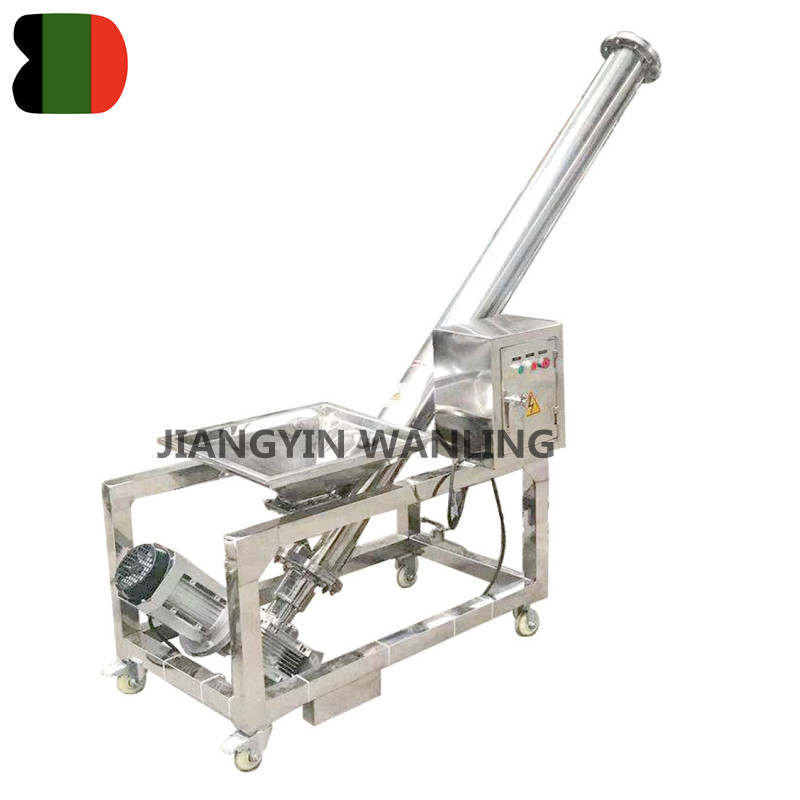 LS Food Granule Screw Conveyor for Short-Distance Material TransferThis stainless steel screw conveyor is suited for controlled feeding of free-flowing dry powders and granules over short horizontal or inclined routes, complementing longer dense phase systems in food, chemical, and pharmaceutical plants.View Product →
For long runs, high throughput, or products that cannot tolerate mechanical handling, dense phase remains the preferred choice. Many food, chemical, and pharmaceutical plants run a combination: vacuum or screw conveying for the short segments, dense phase for the main line between buildings or silos.
Key Considerations Before You Buy
When you spec a dense phase system, the discussion with the supplier should settle at least four points before any equipment is quoted.
- Air supply. Dense phase needs a higher-pressure air source than dilute phase. Decide whether to run a dedicated compressor or tap into plant air. Dedicated supply is usually more reliable, because plant air pressure fluctuates when other equipment starts and stops.
- Line layout. Every bend adds resistance and gives slugs a place to stall. Keep bends to a minimum, use long-radius elbows, and for abrasive products install replaceable wearbacks or ceramic-lined bends.
- Material testing. Never size a dense phase line from bulk density alone. Particle size distribution, moisture content, cohesion, and friability all affect plug formation. A controlled trial on the actual product is the only reliable way to set line diameter, air flow, and pressure.
- Component quality. The blow tank discharge valve, air injection fittings, and pipeline bends fail earliest in abrasive service. Specify components rated for the operating pressure and designed for quick replacement.
Operating cost should also be evaluated honestly. Dense phase systems usually require larger compressors and more energy per tonne conveyed than dilute phase. The payback comes from less product loss, lower maintenance, and fewer line blockages. Plants that run abrasive or fragile products typically recover the difference within the first full production cycle.
The deciding question is simple: what does your product do when it travels at 25 m/s? If the answer is breakage, dust, segregation, or rapid pipe wear, dense phase pneumatic conveying is worth the higher compressor investment. If the product is robust, free-flowing, and the distance is short, a simpler vacuum or screw system will do. In every case, the velocities, pressures, and material behavior measured during a trial with your own product should drive the final specification.