

 Español
Walk through the confectionery aisle of any supermarket and the evidence of chocolate coating technology is everywhere — enrobed biscuits, panned nuts, chocolate-covered fruits, candy shells, protein bars with a glossy outer layer, and ice cream bars with a snapping chocolate coat. Behind every one of these products is a chocolate coating processing machine working with precision to apply, set, and finish a consistent layer of chocolate on a moving stream of centers. Understanding how these machines work — and the breadth of products they make possible — provides both practical insight for food manufacturers considering the technology and a genuine appreciation for the engineering behind everyday confectionery.
Content
- 1 The Core Principle: Controlled Chocolate Application and Setting
- 2 Enrobing Machines: How Full Chocolate Coverage Is Achieved
- 3 Cooling Tunnels: Setting the Chocolate Coating
- 4 Panning Machines: Building Coatings Layer by Layer
- 5 Everyday Products Made by Chocolate Coating Machines
- 6 Tempering Units and Their Integration with Coating Lines
- 7 Cleaning, Changeover, and Hygienic Design Considerations
- 8 Matching Machine Capacity to Production Needs
The Core Principle: Controlled Chocolate Application and Setting
Every chocolate coating process, regardless of the specific machine configuration, rests on two fundamental requirements: applying molten chocolate to the center piece in a controlled, uniform manner, and then solidifying that chocolate rapidly and evenly to create a smooth, stable shell. Both steps are more technically demanding than they appear. Chocolate is a temperature-sensitive suspension of cocoa butter crystals, sugar, and cocoa solids — its viscosity, flow behavior, and setting characteristics change significantly with temperature variations of even one or two degrees Celsius. Managing that temperature precisely throughout the coating cycle is what separates a well-engineered chocolate coating machine from a simple dipping operation.
The chocolate used in coating machines must also be properly tempered before application. Tempering is the process of heating chocolate to melt all crystal forms, cooling it to encourage the formation of stable Form V cocoa butter crystals, then gently warming it back to working temperature. Properly tempered chocolate sets with a glossy surface, a firm snap, and good shelf stability. Untempered or poorly tempered chocolate sets dull, soft, and prone to fat bloom — the white, chalky surface discoloration that develops when unstable cocoa butter crystals migrate and recrystallize at the surface. Modern chocolate coating machines incorporate continuous tempering units that maintain the chocolate in a correctly tempered state throughout the production run, automatically compensating for temperature drift.
Enrobing Machines: How Full Chocolate Coverage Is Achieved
The enrobing machine is the most widely used type of chocolate coating equipment in continuous production environments. Centers — biscuits, wafers, caramel pieces, nougat bars, fruit pieces, or any other item to be coated — are fed onto a wire mesh conveyor belt that carries them through a curtain of flowing chocolate. The chocolate curtain is created by a pump drawing tempered chocolate from a holding tank and delivering it to a distribution head above the conveyor, from which it falls in a smooth, wide curtain across the full belt width. As centers pass through the curtain, their tops and sides are coated. The wire mesh conveyor allows chocolate to flow through the belt and coat the bottom of the centers as well, with excess chocolate falling back into the collection pan below the belt and being recirculated to the holding tank.
The Blower System and Thickness Control
Immediately after passing through the chocolate curtain, centers enter the blower zone — a section where air jets directed at the coated pieces remove excess chocolate and control the final coating thickness. The angle, velocity, and temperature of the air jets are adjustable parameters that give operators precise control over how much chocolate remains on each piece. Stronger air flow removes more chocolate, producing a thinner coat; gentler flow leaves a thicker deposit. The blower also prevents chocolate from accumulating in pools at the base of the center, which would create unsightly "feet" on the finished product. Flat-bottomed products like biscuits are particularly sensitive to foot formation, and blower calibration is critical to producing commercially acceptable results on these items.
The Vibration Table
After the blower, many enrobers incorporate a vibration table — a short section of conveyor that vibrates at a controlled frequency to level the freshly applied chocolate coating and eliminate surface irregularities before the chocolate begins to set. The vibration encourages the still-liquid chocolate to flow to a uniform thickness and eliminates air pockets or drag marks introduced during the curtain application. For products where surface appearance is a key quality attribute — premium chocolate truffles or enrobed biscuits for gift packaging, for example — the vibration table is an important factor in achieving the smooth, professional surface finish that consumers associate with quality.
Cooling Tunnels: Setting the Chocolate Coating
Once coated, products enter a cooling tunnel — an enclosed, refrigerated conveyor section where the chocolate coating solidifies under controlled temperature and airflow conditions. The cooling tunnel is not simply a cold chamber; its temperature profile is carefully engineered to achieve fast, uniform setting without introducing temperature shock that could cause the chocolate to contract too rapidly, crack, or develop bloom. A typical cooling tunnel for enrobed products operates in zones: an initial zone at around 12–15°C encourages rapid crystallization of the cocoa butter without overcooling; a middle zone at 8–12°C accelerates setting; and a final zone at slightly higher temperature prevents condensation from forming on the finished product as it exits the tunnel into the ambient factory environment.
Tunnel length and belt speed are matched to the thermal mass of the coated product and the chocolate coat thickness. Thicker coatings require longer tunnels or slower belt speeds to allow heat to dissipate from the interior of the chocolate layer. Inadequate cooling time results in soft-set chocolate that deforms during downstream handling, while excessive cooling can cause the chocolate to crack or peel from the center due to differential thermal contraction. Modern cooling tunnels use variable-speed fans, independently controlled temperature zones, and humidity management to provide the precise thermal environment needed for consistent results across different product types and chocolate formulations.
Panning Machines: Building Coatings Layer by Layer
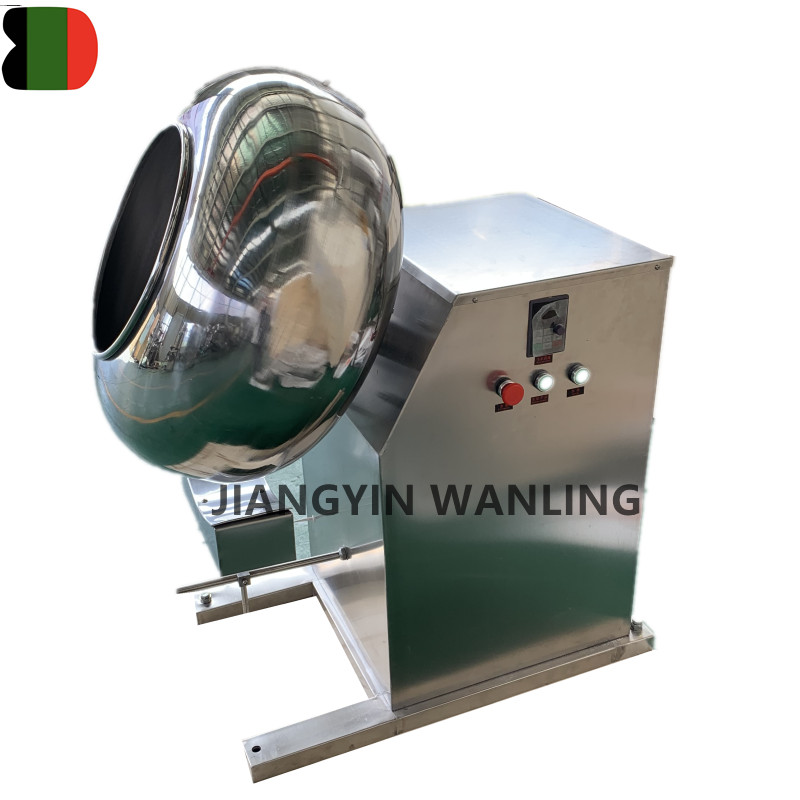
While enrobing applies chocolate in a single continuous pass, panning builds up a chocolate coating through the repeated application of thin layers on tumbling centers. A chocolate panning machine consists of a rotating tilted drum — the pan — in which centers tumble continuously. Chocolate is added in small increments to the tumbling mass, each addition coating the surfaces of the centers as they roll against each other and the pan wall. After each addition of chocolate, the pan environment is cooled (either by chilled air blown into the pan or by a jacketed pan wall) to set the applied layer before the next addition is made.
The panning process is slower than enrobing but produces results that enrobing cannot — perfectly round, uniformly coated pieces where every surface, including deep crevices in irregular centers like nuts or dried fruits, receives an even coating. The multiple thin layers also build up a coating with specific structural properties: the many crystallized layers create a shell that is denser and more mechanically robust than a single thick enrobed coat. This makes panning the preferred process for products that require the coating to withstand significant mechanical stress — sugar-shelled chocolates, chocolate-covered nuts, and pharmaceutical-style candy tablets are all panned products.
Everyday Products Made by Chocolate Coating Machines
The range of consumer products produced using chocolate coating processing machines is far broader than most consumers realize. The following table illustrates the diversity of applications and the machine type typically used for each.
| Product | Coating Method | Key Machine Feature |
| Chocolate biscuits and wafers | Enrobing | Wide belt, precision blower for foot control |
| Chocolate-covered nuts and raisins | Panning | Rotating drum, chilled air system, polishing pan |
| Truffle shells and pralines | Enrobing | Vibration table, precise tempering unit |
| Candy-shelled chocolates (M&M style) | Panning (chocolate + sugar shell) | Multi-stage pan system with sugar and polish stages |
| Ice cream bars | Dipping / enrobing | Low-viscosity compound coating, rapid-set tunnel |
| Protein and energy bars | Enrobing | High-throughput belt, compound chocolate handling |
| Chocolate-covered fruits (strawberries, cherries) | Enrobing or dipping | Gentle handling conveyor, short tunnel for delicate pieces |
Tempering Units and Their Integration with Coating Lines
A chocolate coating machine is only as good as the tempered chocolate feeding into it. Continuous tempering machines — either standalone units connected to the enrober by insulated pipes or integrated directly into the enrober's chocolate circuit — maintain chocolate in a correctly tempered state throughout the production day. A continuous tempering machine works by heating chocolate to fully melt all crystal forms (typically to around 45–50°C for dark chocolate), then cooling it through a scraped-surface heat exchanger to around 27°C to encourage Form V crystal nucleation, then gently warming it to working temperature (31–32°C for dark chocolate, 29–30°C for milk, 28–29°C for white) at which it is fluid enough to coat but populated with enough stable seed crystals to set correctly.
The tempering degree — a measure of the number and stability of cocoa butter crystals in the working chocolate — is monitored continuously by an instrument that measures the chocolate's viscosity and heat release profile during controlled cooling. Modern enrobing lines display the tempering index in real time and can automatically adjust the tempering machine's cooling parameters to maintain the target tempering degree as throughput rates, ambient temperature, or chocolate formulation variables change during a production shift. This closed-loop tempering control is what allows industrial coating lines to run for eight to sixteen hours continuously while maintaining consistent surface gloss and setting behavior on every piece produced.
Cleaning, Changeover, and Hygienic Design Considerations
Chocolate coating machines operate in food production environments and must be designed for efficient cleaning and allergen-safe changeover between different chocolate types or product runs. The transition from dark to milk chocolate — or from a nut-containing product to a nut-free one — requires thorough purging and cleaning of all chocolate-contact surfaces to prevent cross-contamination that could trigger allergic reactions in sensitive consumers. Modern chocolate coating machines address this through several design features:
- Smooth, crevice-free internal surfaces: All chocolate-contact components — tanks, pipes, pumps, distribution heads, and collection pans — are manufactured in food-grade stainless steel with smooth internal surfaces and radiused corners that prevent chocolate residue from accumulating in inaccessible areas.
- Quick-release fittings and removable components: Conveyor belts, blower nozzles, distribution heads, and drip trays are designed for tool-free removal, allowing thorough manual cleaning without disassembling the machine's structural frame.
- Chocolate changeover by flushing: Many machines allow the current chocolate to be flushed from the system using a chocolate of the same type (to minimize waste) before the new chocolate is introduced, reducing the volume of mixed or cross-contaminated chocolate that must be discarded.
- CIP (Clean-In-Place) compatibility: Some high-throughput industrial coating lines incorporate CIP systems that circulate warm water and food-safe cleaning agents through the chocolate circuit under automatic control, reducing manual cleaning labor and ensuring consistent cleaning effectiveness across all interior surfaces.
Matching Machine Capacity to Production Needs
Chocolate coating machines are available across a wide range of production capacities, from small-scale artisan enrobers with belt widths of 200–300mm and throughputs of 50–150 kg/hour, to industrial enrobing lines with belt widths of 1,000–1,500mm and throughputs exceeding 2,000 kg/hour. Selecting the right capacity involves more than matching the machine's rated throughput to the required production volume — it also requires considering the diversity of products to be run on the machine, the frequency of changeovers, the available floor space and utility connections (the cooling tunnel alone can extend 8–15 meters), and the level of automation required for downstream handling after the coating tunnel.
For manufacturers running a single product at high volume, a dedicated high-capacity enrobing line optimized for that product's specific center geometry and chocolate type will deliver the lowest per-unit cost and highest consistency. For manufacturers running frequent short production runs of diverse products, a mid-capacity machine with quick-changeover features, flexible blower adjustment, and easy belt removal will offer better overall economics despite its lower peak throughput. The right chocolate coating processing machine is ultimately the one sized and configured for the actual production reality, not the theoretical maximum output, of the operation it serves.